AI content generation in 2026 is no longer about typing a prompt into ChatGPT and copying the result. It is about pipelines: brand voice configs, knowledge bases, consistent visual characters, image and video models stitched into a single workflow, and an orchestration layer that produces 30+ pieces of on-brand content per week without a human touching every step. This guide breaks down what works, what does not, and how the stack actually fits together.
Short answer: AI content generation works when you stop using generic writers and start building a content system. The minimum stack for 2026 is: a brand voice profile (more than a tone slider), a knowledge base the model can retrieve from, an image model that holds a visual character across outputs, a video pipeline, and a scheduler. Tools like ChatGPT, Jasper, and Copy.ai cover step one. Platforms built for output, like ACA, cover all five inside one workspace.
What Is AI Content Generation in 2026?
AI content generation is the use of machine learning models to produce written, visual, video, and audio content from structured inputs (prompts, brand profiles, knowledge bases, source material). It covers everything from a single LinkedIn post drafted in ChatGPT to a 30-post-per-week multi-format pipeline that publishes carousels, reels, newsletters, and articles for an agency's client roster.
The category has split in two over the last 18 months. On one side, generic writing tools that take a prompt and return text or an image. On the other, content operating systems that combine multiple models, retain brand context, and produce output across formats without a person rewriting every line. The first category is a feature. The second is a workflow.
AI content generation is the automated production of text, image, video, and audio content using foundation models (large language models, diffusion models, text-to-speech engines, and rendering frameworks) guided by structured brand inputs. In 2026, production-grade AI content generation refers to multi-format pipelines that maintain brand voice, visual identity, and factual accuracy across outputs, not single-prompt outputs from a chat interface.
Why Generic AI Tools Fail at On-Brand Content
If you have tried producing content at scale with ChatGPT, Jasper, or Copy.ai, you already know the failure modes. They are not subtle.
Voice drift. The model has no persistent memory of how your brand sounds. You paste a tone document at the top of every prompt, but by post three the voice slides back toward the model's default register: hedged, generic, vaguely corporate. Without a system that re-injects voice context on every generation, you are doing manual prompt engineering forever.
Visual inconsistency. Generic image tools generate a different character every time you ask. The founder in your reel last week looks nothing like the founder in this week's carousel. For personal brands and faceless brands alike, this kills recognition.
No retrieval. A generic AI writer cannot read your past content, your offer documents, your case studies, or your call transcripts. It writes from training data, which means it cannot reference what your business actually does without you re-explaining it in every prompt.
Single-format output. ChatGPT writes text. Midjourney makes images. Pika makes video. ElevenLabs does voice. None of them produce a coordinated multi-format release for a single piece of source material. You become the integration layer, copying outputs between five tools.
No scheduling, no publishing. Generic tools generate; they do not deliver. The content sits in your tabs until you manually post it.
These are not edge cases. They are the structural limits of a chat interface wrapped around a foundation model. To produce real content output at agency scale, you need a system that holds state across all five problems.
The Four Formats: Text, Image, Video, Audio
Modern AI content generation operates across four output formats. Each has its own model class, its own quality bar, and its own integration requirements. Understanding the stack at each layer is what separates people who post AI slop from people who produce content their audience cannot tell was generated.
Text generation
The text layer is the most mature. Large language models like GPT-4 class, Claude class, and the open models from Llama and Mistral families produce passable copy on the first prompt and excellent copy with the right context. The differentiator in 2026 is not the model. It is the prompt scaffolding around it.
A production text pipeline looks like this:
- Brand voice profile with vocabulary lists, banned phrases, sentence-length preferences, and tonal range examples (not a 1-to-10 slider).
- Format template that defines the structure of the output: hook, body, payoff, CTA pattern.
- Knowledge retrieval that pulls relevant context (past posts, offer documents, case studies) before generation.
- Source material: a transcript, a meeting note, a research document, or a competitor analysis the model uses as raw input.
- Post-generation pass that checks for voice violations and rewrites failing sections.
Skip any of these and you get generic output. Combine all five and you get content that reads like your best writer wrote it after a strong coffee.
Image generation
Image generation in 2026 is dominated by a few model families: the GPT-Image line (including the nano-banana-2 generation used by ACA's image pipeline), Midjourney v7+, Flux, and the various open Stable Diffusion descendants. The differences matter less for the casual user than for the production user.
Production image generation requires three things generic tools do not give you:
- Character consistency: the same person, mascot, or visual signature across every image, even months apart.
- Style consistency: a defined visual identity (color palette, composition rules, illustration style) the model holds across outputs.
- Format-aware composition: vertical for Reels, square for carousels, 16:9 for thumbnails. The model has to compose for the destination, not crop after.
The nano-banana-2 class of models, when properly prompted with reference images and a locked style guide, can produce dozens of on-brand outputs in a single batch. The catch: the style guide and reference workflow has to be built into the tool. Hitting the model directly from a chat box gives you a different look every time.
Video generation
Video is the format that broke open in 2025-2026. There are two production approaches now, and they solve different problems.
End-to-end generative video (Sora, Runway Gen-4, Pika, Veo): you prompt and the model generates motion. Useful for B-roll, atmospheric inserts, and abstract visuals. Limitations: characters drift across clips, lip sync is imperfect, costs add up fast for longer formats, and you cannot easily edit a generated frame after the fact.
Programmatic video (Remotion and similar React-based renderers): you compose video like you compose a webpage. AI generates the script, voiceover, and stock-style images; a programmatic renderer assembles them into a timed video with captions, transitions, and brand-consistent overlays. Useful for talking-head reels with a virtual presenter, faceless YouTube content, founder personal brands, and any format where you need 30 videos a month with reliable consistency.
For most agencies and creators in 2026, programmatic video is the right call. It is cheaper, more predictable, and produces a stronger brand match than pure generative video for the next 12-18 months.
Audio and TTS generation
Text-to-speech is the layer most teams ignore until they try to scale video. Modern TTS models (ElevenLabs, OpenAI's TTS, and the open Bark and StyleTTS-2 families) produce voice output that is indistinguishable from a recorded human in a controlled setting. The catch is voice cloning ethics and platform terms: clone your own voice, get written consent from anyone else's, and read the TOS of the destination platform before publishing.
A production audio pipeline includes voice cloning (your voice, not a stranger's), prosody control (pauses, emphasis, pacing), and the integration into the video render so audio and visuals stay locked together. ACA's content pipeline handles this natively; assembling it from scratch with ElevenLabs and Remotion is a one-week engineering project.
Brand Voice Systems That Actually Work
A brand voice slider is theater. Real brand voice in AI content generation requires a structured profile the model can reference on every generation. The components:
- Vocabulary lists: words you use ("outbound", "pipeline", "workflow"), words you do not ("revolutionary", "synergy", "in conclusion"), and the brand-specific terminology only you use.
- Sentence rhythm preferences: do you write short and punchy, or do you let sentences run? Define the average length, the variance, and the rules.
- Tonal range: not a single tone but a range with examples. Casual-for-LinkedIn, direct-for-cold-email, technical-for-blog.
- Banned phrases and clichés: the specific dead phrases that immediately signal AI output. Maintaining this list is ongoing work.
- Reference samples: 10-20 pieces of your best past content that the model can match against.
The mistake most teams make is treating brand voice as a prompt prefix. It is not. It is a configuration object that gets retrieved and injected on every generation, alongside the format template and the source material. Without that retrieval layer, you are pasting the same 800-word voice document into ChatGPT 30 times a day and wondering why output drifts.
In our experience running ACA's content pipeline across hundreds of brand voices: the difference between a sloppy AI content output and a production-grade one is rarely the model. It is whether the brand voice profile contains specific vocabulary lists and reference samples versus a generic tone slider. A well-built voice profile reduces post-generation editing time from 40-60% of the workflow to under 10%.
Characters and Visual Consistency Across Outputs
If you run a personal brand or a faceless brand, you need a visual character that does not change every time you generate an image. This is the part of AI image generation that single-prompt tools do worst.
Three approaches to character consistency in 2026:
- Reference image conditioning: feed the model a locked reference photo or set of photos every generation. Modern image models (including nano-banana-2 class) hold likeness well when given consistent reference input. This is the simplest approach and works for most personal brands.
- LoRA fine-tunes: train a small adapter on 20-50 images of your character. The model then generates that character on demand. Higher quality and more flexibility, but more setup work, and not all platforms expose LoRA training.
- Composed pipelines: generate a face with one model, generate a scene with another, composite them. Used for hyper-specific brand requirements but harder to maintain.
Whichever route you pick, the character has to live as a first-class asset in your content system. You define it once. Every image generation references it. This is how a faceless YouTube brand can have a consistent virtual host across 200 videos, or how a founder personal brand can publish 30 carousel posts a month with a recognizable visual signature.
Knowledge Bases: The Layer That Makes Output Actually Yours
The single biggest leap in AI content quality between 2023 and 2026 is retrieval. Without a knowledge base, the model writes from its training data. With one, it writes from your actual business context: your offer, your case studies, your past content, your customer language, your sales call transcripts.
A production knowledge base for content generation contains:
- Offer documents: pricing pages, service descriptions, deliverables, FAQs.
- Case studies and proof: results, testimonials, before/after framing.
- Past content archive: every blog post, LinkedIn post, newsletter you have published, indexed for retrieval.
- Call transcripts: sales calls, customer interviews, podcast appearances. The language your customers actually use.
- Competitor and category context: what others in your space publish, framed as either reference or contrast.
When a generation runs, the system retrieves the relevant chunks from this knowledge base and includes them in the prompt context. The output references real specifics from your business, not generalities from the model's training data. This is what kills the "AI sounds AI" problem more than any prompt-engineering trick.
Multi-Format Pipelines: One Source, Many Outputs
The highest-leverage move in AI content generation is the multi-format pipeline. One source asset (a long-form article, a podcast episode, a sales call, a webinar) becomes 10 to 30 derivative pieces across formats.
A standard pipeline:
- Source ingestion: a long-form asset goes in. Could be a 60-minute podcast transcript, a 3,000-word essay, or a customer call recording.
- Outline extraction: the model identifies 15-25 distinct ideas or claims worth their own post.
- Format routing: each idea is routed to the right format. Quick insight to a LinkedIn text post. Step-by-step idea to a carousel. Personality moment to a reel. Technical depth to a newsletter section.
- Per-format generation: each output is generated with format-specific prompts, brand voice retrieval, and knowledge base context.
- Asset generation: images, carousel slides, video frames, voiceover audio are produced for each piece.
- Scheduling and publishing: outputs are queued into a content calendar and published on schedule to the right channels.
Run this pipeline weekly with a single 60-minute source recording and you produce more high-quality content in a month than most agencies produce in a quarter. The leverage is not the model. It is the pipeline.
The AI Content Generation Tooling Landscape
The tools available in 2026 split into four tiers based on what they actually do for a production workflow.
| Tier | Examples | What it does | What it is missing |
|---|---|---|---|
| Chat interface | ChatGPT, Claude, Gemini | Single-prompt text and basic image output | Brand voice memory, retrieval, multi-format, scheduling |
| Specialized writers | Jasper, Copy.ai, Writesonic | Templates for marketing copy, light brand voice config | Multi-format output, image/video, knowledge bases, scheduling |
| Single-format generators | Midjourney, ElevenLabs, Runway, Pika | Best-in-class output for one format | Cross-format coordination, brand systems, publishing |
| Content operating systems | ACA | Multi-format pipelines, brand voices, characters, knowledge bases, scheduling, white-label for agencies | Not the right pick if you only need one-off prompts |
The right tool depends on your workload. If you write the occasional LinkedIn post by hand and want help with the rough draft, ChatGPT is fine. If you need 30 pieces of on-brand content per week across formats, and especially if you are doing this for clients, you need the operating-system tier.
How ACA Approaches AI Content Generation
ACA was built for the second case. The platform combines four content systems into a single workspace:
- Brand voice profiles with vocabulary lists, banned phrases, sentence rhythm rules, and reference samples per client or per project.
- Knowledge bases that ingest offer documents, past content, transcripts, and case studies, then retrieve relevant context on every generation.
- Characters for visual consistency, locked via reference images and applied to every image and video output.
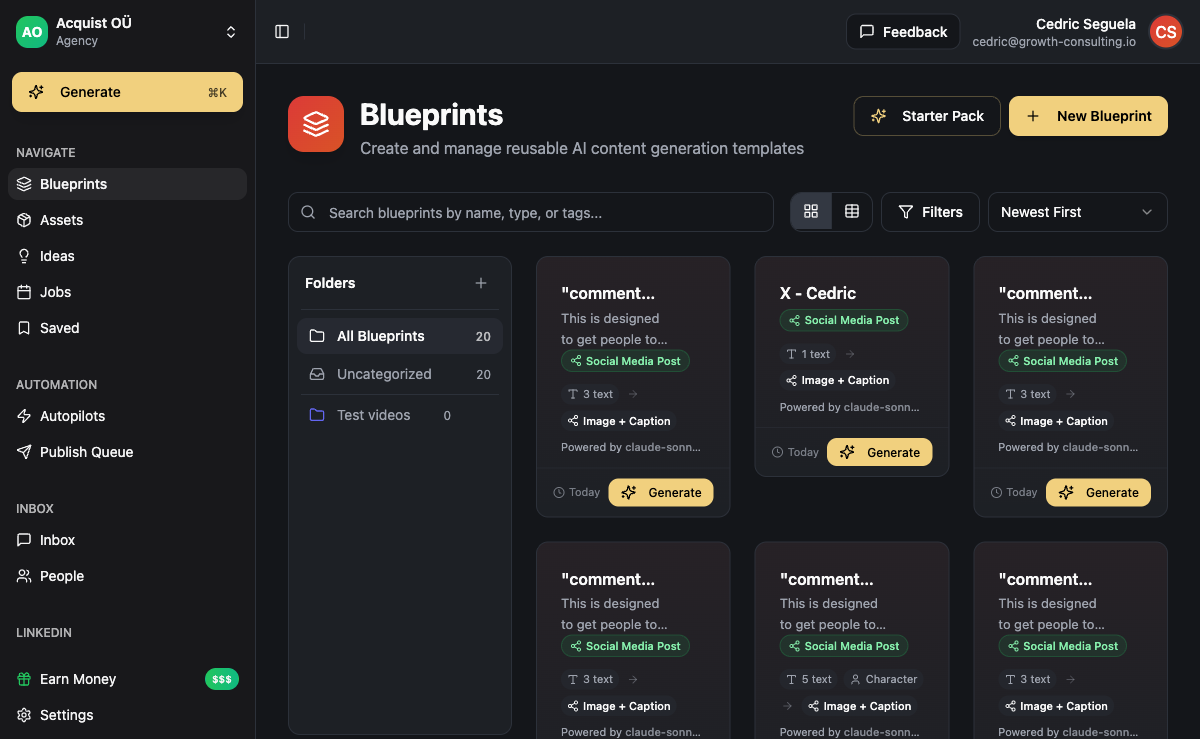
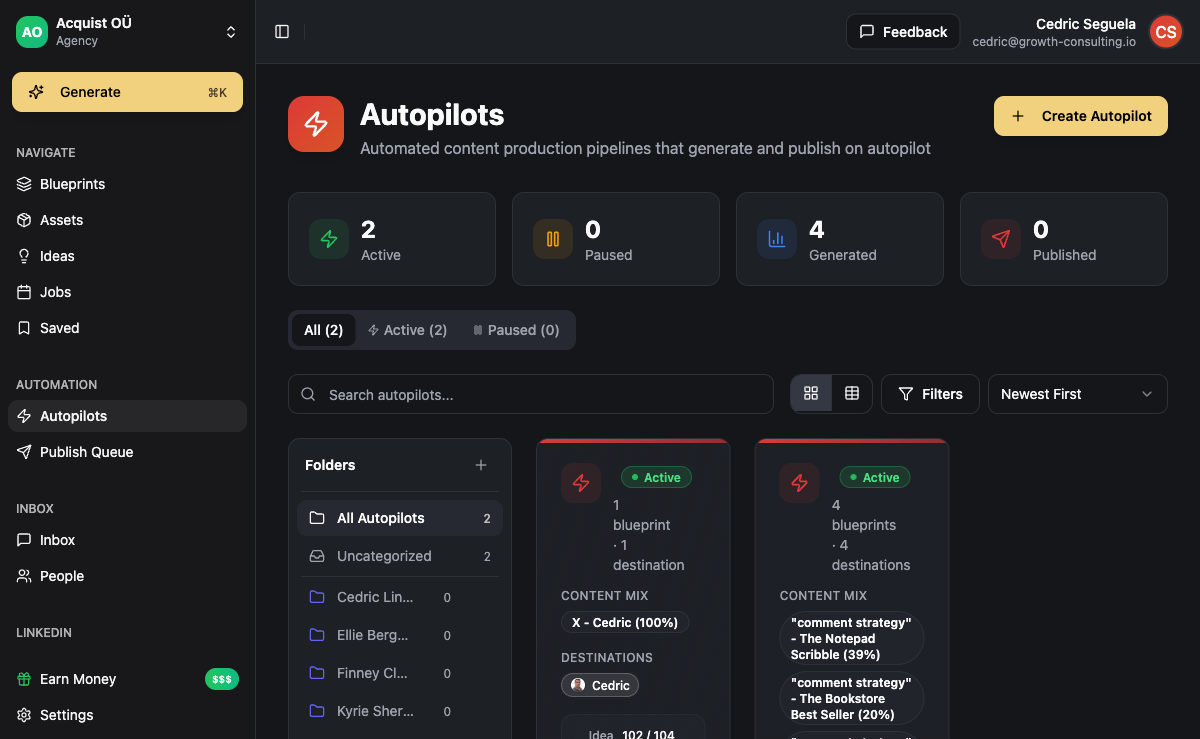
- Blueprints: reusable templates that define a multi-format pipeline from source asset to published output, runnable on a schedule.
The image layer runs on the nano-banana-2 class of models with reference conditioning for character consistency. The video layer uses Remotion under the hood, which produces programmatic video with TTS voiceover, captions, and brand-locked visual templates. The text layer uses LLMs configured per brand voice, with knowledge base retrieval on every call.
For agencies, every component is white-label and isolated per client workspace. You run ten clients through the platform; each one has its own brand voice, character, knowledge base, and content calendar. None of it bleeds across.
The platform uses a BYOK (bring your own key) model on AI costs, which means you pay actual API usage instead of marked-up per-seat content credits. For an agency producing 30+ pieces per client per month, this is the difference between a 40% margin and an 80% margin.
Common Mistakes Teams Make With AI Content
Patterns that show up over and over:
- Treating the model as the system. The model is one component. The system is brand voice + knowledge + format + asset generation + scheduling. Optimizing the model without the rest is rearranging deck chairs.
- Posting raw output. Even with a strong pipeline, a 10% human review pass catches the small voice slips that compound. Skip this and the audience eventually notices.
- Generating without distribution. Producing 50 pieces a week with no scheduler, no distribution channels, and no analytics is a content factory with no warehouse. Output rots in drafts.
- Cloning a competitor's voice. The model can imitate any voice. Imitating a competitor produces content that sounds like a worse version of them. Build your own voice profile, even if it takes a month to dial in.
- Ignoring image and video. Text-only content publishing in 2026 underperforms multi-format publishing on every major platform. The teams winning are the ones who treat image and video as default outputs, not enhancements.
Use a chat-based AI writer when: you produce occasional content by hand, you do not have a defined brand voice yet, you are still figuring out what to publish.
Use a specialized writer like Jasper when: you produce volume marketing copy in a single format and your brand voice fits a template-friendly mold.
Use a content operating system like ACA when: you produce multi-format content at scale, you run an agency with multiple clients, you need brand voice and visual consistency across hundreds of outputs, and you want the pipeline to run on a schedule without you driving every step.
Building Your AI Content Stack in 2026
If you are starting fresh, the practical order:
- Define your brand voice in writing. Vocabulary lists, banned phrases, sentence rhythm, tonal range, 10-20 reference samples. This is the work you cannot skip.
- Build your knowledge base. Pull together offer documents, past content, transcripts, case studies. Index them in a tool that supports retrieval.
- Lock your visual identity. Pick a character (yourself, a brand mascot, or a defined visual signature). Generate reference images you will use across every output.
- Pick your formats. What goes on LinkedIn, what becomes a carousel, what becomes a reel, what becomes a newsletter section. Define a routing rule.
- Set the schedule. How many pieces per week per format. What days. What times. Pipelines without schedules do not run.
- Pick the platform. Generic writer if your volume is low, content OS if your volume is high or you are doing this for clients.
- Run a 30-day pilot. Output, review, adjust. The first three weeks of any new content system are dialing in the brand voice. Expect 30-50% edit overhead at the start, dropping below 10% by week four.
The teams that win at AI content generation in 2026 are not the ones with the best models. They are the ones with the cleanest pipelines. The model gets better every six months on its own. The pipeline is what you build.
Frequently Asked Questions
What is the best AI for content generation in 2026?
There is no single best AI. For text, GPT-4 class and Claude class models are interchangeable for most marketing content. For image, the nano-banana-2 generation and Midjourney v7+ lead for production quality. For video, Remotion-based programmatic pipelines beat pure generative video for brand consistency. The right answer for most teams is not picking a model but picking a content operating system that integrates multiple models behind a brand voice and knowledge layer.
Can AI-generated content rank on Google in 2026?
Yes, when it meets Google's quality bar. The 2024-2025 Helpful Content updates targeted thin AI content with no original perspective, not AI assistance generally. AI content that draws on your real expertise, references your case studies, and answers questions better than the existing top results ranks. AI content that paraphrases the top three SERP results does not. The difference is the knowledge base layer.
How is AI content generation different from AI copywriting tools like Jasper?
Jasper, Copy.ai, and similar tools are specialized writers focused on marketing copy in a single format (mostly text). They include templates and basic brand voice configs but do not handle image, video, audio, multi-format pipelines, knowledge base retrieval, or scheduling. AI content generation as a category in 2026 includes all of those layers. Specialized writers are a subset.
How much does AI content generation cost?
Costs split into platform fees and AI API usage. Chat-based tools like ChatGPT cost $20-25 per month per user. Specialized writers run $50-150 per month per seat. Content operating systems with BYOK pricing run lower flat platform fees plus actual API costs, which for a single brand producing 30 pieces a week sit in the $20-60 per month range for AI usage. Agencies running 5-10 clients on a BYOK system typically see total AI costs under $300 per month across all clients.
Does AI content generation replace writers and content teams?
It replaces the production layer, not the strategy layer. Defining brand voice, building knowledge bases, deciding what to publish, reviewing output for the 10% that needs a human eye, and responding to comments and replies all remain human work. Teams that adopt AI content generation typically keep the same headcount but shift roles from drafting to systems, strategy, and review. Output per person goes up 5-10x.
What is the role of TTS and voice cloning in AI content?
TTS (text-to-speech) is what unlocks programmatic video at scale. A script generated by an LLM gets converted to voiceover by a cloned voice, then composited into video by a tool like Remotion. The output is a 30-60 second reel with on-brand visuals, captions, and the founder's voice (or a permitted voice) without anyone recording audio. The ethics are simple: clone your own voice, get written consent for anyone else's, and follow platform terms.
What is the difference between generative video and programmatic video?
Generative video models (Sora, Runway, Pika, Veo) produce motion from a prompt. Useful for B-roll and atmospheric inserts but characters drift and costs scale fast. Programmatic video (Remotion and similar) composes video like a webpage: defined timing, transitions, captions, and image inserts assembled by code. For most agency and creator workflows in 2026, programmatic video produces better brand consistency and lower cost per output than pure generative video.
Can I build all of this myself instead of using a platform?
Yes. The components exist as APIs: an LLM provider, an image model API, ElevenLabs for TTS, Remotion for video rendering, a vector database for retrieval, a scheduler. Building the pipeline yourself is a 4-8 week engineering project for a competent developer and ongoing maintenance after. Most agencies and founders find the build-vs-buy math favors a platform once they cost out the engineering time. Solo developers with strong infrastructure skills sometimes prefer to build.