
AI lead generation in 2026 is not a chatbot that scrapes emails. It is a full-stack system - ICP targeting, multi-channel outreach, real-time personalization, automated qualification, and appointment setting - running 24/7 without a sales team. Agencies that build this system for clients are charging $2,000-$5,000/month per account and delivering more pipeline than a 3-person SDR team ever could.
What Is AI Lead Generation?
AI lead generation is the use of artificial intelligence to identify, reach, qualify, and convert prospects into booked meetings - with minimal human intervention. It replaces the manual grind of the traditional outbound process: researching leads by hand, writing one-off emails, following up sporadically, losing warm signals in a spreadsheet.
The full system covers five layers:
- Targeting: AI scores and filters leads against your Ideal Customer Profile
- Outreach: Automated sequences across LinkedIn, email, WhatsApp, and Instagram
- Personalization: AI-generated opening lines and messages tailored to each prospect
- Qualification: AI agents that respond to replies, handle objections, and score intent
- Booking: Calendar integration that books meetings directly when a prospect is ready
When all five layers run together, you get a system that can process thousands of leads per month and surface the 2-5% who are ready to buy - without a human touching a spreadsheet.
Why Traditional Lead Generation Is Broken
The standard B2B lead generation playbook from 2018-2022 does not work anymore. Here is why:
Email inboxes are more protected than ever
Gmail and Outlook rolled out stricter deliverability requirements in 2024-2025. Bulk senders without proper domain authentication, sending patterns that spike, and high-volume blasts from fresh domains get filtered before they are ever seen. The spray-and-pray cold email approach is effectively dead for anyone who has not invested in technical setup.
LinkedIn manual outreach does not scale
Sending 20-30 connection requests per day manually, following up by hand, tracking responses in a Google Sheet - that might land you 2-3 conversations per week on a good week. It does not scale past 1-2 client accounts. And the moment you try to automate it with a clunky Chrome extension, LinkedIn flags your account.
Single-channel thinking kills conversion
Buyers do not live in one channel. A decision-maker might ignore your LinkedIn DM but respond to an email. They might miss your email but reply to a WhatsApp message when they are commuting. Running a single-channel outreach operation means you are leaving 60-70% of your addressable market untouched.
No follow-up system means warm leads go cold
Most businesses lose the majority of their warm leads not because they said no - but because no one followed up fast enough. A prospect downloads your lead magnet at 11 PM. You check your email at 9 AM. By then, they have already talked to a competitor who had an automated follow-up running.
How AI Lead Generation Actually Works
Here is the architecture of a working AI lead generation system - the kind agencies build for clients and charge $2,000-$5,000/month to manage.
Step 1: AI-Powered ICP Targeting
Before you send a single message, you need the right people in the list. AI ICP scoring takes a defined set of criteria - industry, company size, revenue range, job title, tech stack, hiring signals, LinkedIn activity, recent funding - and scores every prospect in your database against them.
The result: instead of importing a raw list of 10,000 names and blasting everyone, you send to the 1,500 who actually match. Your reply rates go up. Your deliverability improves. Your sales cycle shortens because you are talking to people who actually have the problem you solve.
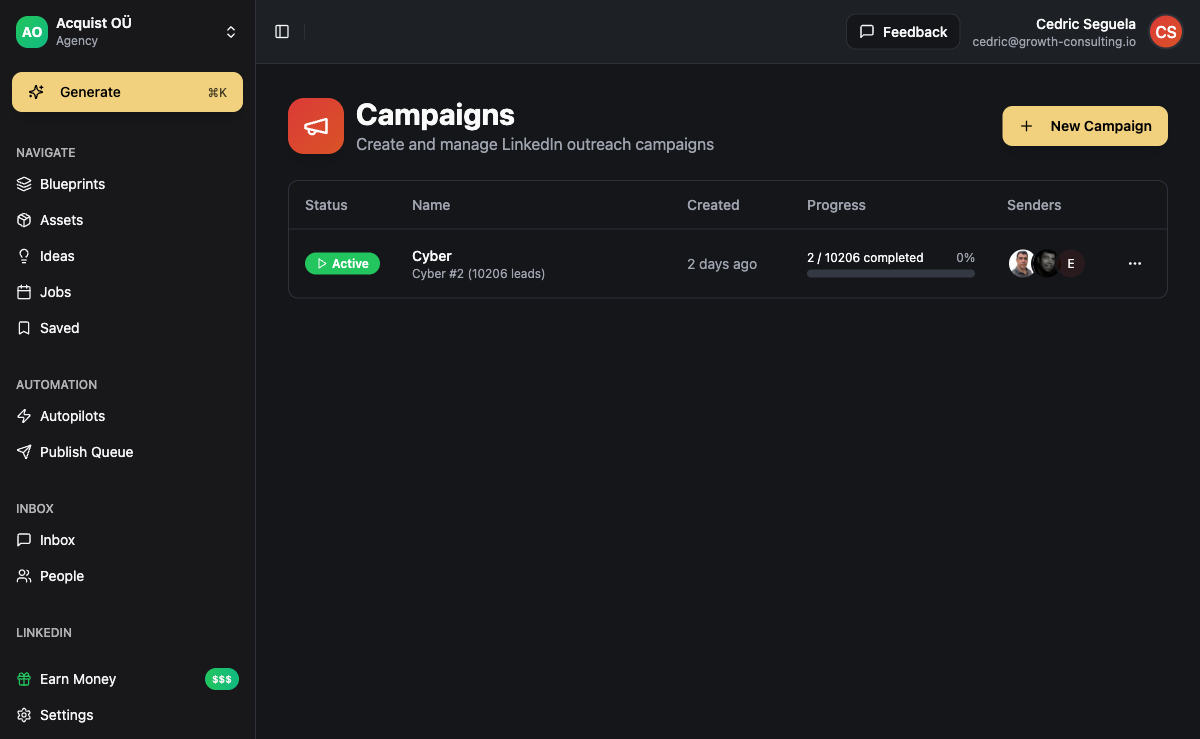
ACA's ICP scoring engine lets you define these criteria per client workspace and auto-scores new leads as they come in. High-fit prospects get routed to active campaigns. Low-fit prospects get deprioritized. The list stays clean.
Step 2: Multi-Channel Outreach at Scale
The days of a single outreach channel are over. The agencies generating the most pipeline for clients run 3-6 channels simultaneously from a single orchestrated sequence:
- LinkedIn: Connection request + message sequence. Best for senior B2B decision-makers. High trust, lower volume than email.
- Email: Higher volume, works well for mid-funnel nurture and technical buyers. Requires solid deliverability infrastructure (custom domain, warmed inbox, DKIM/SPF/DMARC).
- WhatsApp: Highest open rates of any channel - often 80-90% for the right audience. Works especially well in markets outside North America, and for industries where WhatsApp is part of the daily workflow.
- Instagram DM: Effective for B2C-adjacent niches - coaches, course creators, service businesses with a social following.
- SMS: Reserved for warm leads who have already engaged. Not for cold outreach.
The key is orchestration. When a prospect does not respond to LinkedIn after 3 touch points, the sequence automatically escalates to email. No reply after 2 emails, it tries WhatsApp. You are not manually tracking who got what message on what channel - the system handles that.
Step 3: Personalization at Scale
Personalization is the single biggest lever for cold outreach performance. A message that references something specific about the prospect - their recent LinkedIn post, a company announcement, their exact job title and a relevant pain point - outperforms a generic template by 3-5x on reply rate.
The problem: real personalization at scale is impossible to do manually. If you are running 500 outreach touches per week per client, you cannot write a custom first line for each one.
AI solves this. For each prospect, the AI reads their LinkedIn profile, recent activity, company data, and job role - and generates a personalized opening line. Not a merge tag swap. An actual sentence that reads like you wrote it specifically for them.
Example of AI-generated personalization:
"Saw your post about scaling your recruiting team in Q1 - curious if you're still handling LinkedIn sourcing manually or if you've built any automation into the process."
That kind of opening gets replies. The generic "I noticed you work at [Company]" does not.
Step 4: Automated Lead Qualification
When a prospect replies, most businesses lose the momentum. The reply sits in an inbox for 8 hours. Someone finally responds with a calendar link. The prospect goes cold.
AI qualification changes this. When a prospect replies to any channel - LinkedIn DM, email, WhatsApp - an AI agent picks up the conversation within minutes. It qualifies the prospect against pre-set criteria (budget, timeline, decision-making authority, current solution), handles common objections, and either books the meeting or flags it for human review.
This is not a chatbot that says "Thanks for your interest! Someone will be in touch." It is an AI that holds a real conversation, adapts to what the prospect says, and moves them through the sales process.
Step 5: AI Appointment Setting
The final step is booking. When a prospect is qualified and interested, the AI presents available times (synced with the client's real calendar), confirms the meeting, sends a confirmation, and adds any context notes for the sales rep before the call.
The rep shows up to a call where the AI has already qualified the prospect, captured their pain points, and briefed them on the context. Not a cold "let's connect" meeting - a warm, pre-qualified discovery call.
AI Lead Generation for Agencies: The Business Model
If you are an agency owner, this system is the product you sell - not as a technology demo, but as a managed service with a monthly retainer tied to outcomes.
Here is how to structure it:
| Service Tier | What You Deliver | Monthly Price |
|---|---|---|
| Starter | 1 channel (LinkedIn or email), ICP targeting, 500 outreach touches/month | $1,500-$2,000 |
| Growth | 3 channels, AI personalization, automated qualification, 1,500 touches/month | $3,000-$4,000 |
| Scale | Full 5-layer system, 4+ channels, AI appointment setting, 5,000+ touches/month | $5,000-$8,000 |
The delivery cost on a platform like ACA - covering multi-channel infrastructure, AI API usage, and inbox management - typically runs $100-$400/month per client depending on volume. That leaves substantial margins even at the Starter tier.
The key to client retention is showing pipeline impact in the first 30 days. Set up a simple dashboard: contacts reached, reply rate, conversations started, meetings booked. Clients who see meetings being booked in week 2 stay for years. Clients who see nothing in 30 days churn.
For a deeper look at the full agency model: How to Start an AI Agency in 2026.
Choosing the Right AI Lead Generation Platform
The platform you choose determines your margins, your operational complexity, and what you can actually deliver to clients. Here is what matters:
Multi-channel from a single dashboard
If your platform only does email, you are leaving LinkedIn, WhatsApp, and Instagram leads on the table. Look for a platform that orchestrates all channels from one interface - not 4 separate tools that you manually sync.
BYOK (Bring Your Own Keys)
Platforms that charge per AI-generated message add up fast across 10+ clients. BYOK means you connect your own API keys (OpenAI, Anthropic, etc.) and pay actual usage rates - typically $0.01-$0.05 per message. The economics are completely different from $0.10-$0.25 per message on a locked platform.
White-label for agencies
If you are running an agency, your clients should see your brand - not the platform's. White-label support means each client logs in to a sub-account under your domain, with your logo. This builds perceived value and makes it harder for clients to bypass you and go direct to the tool.
Unified inbox
When you are running 5 channels simultaneously for 10 clients, you need one place where every reply lands - LinkedIn DMs, email replies, WhatsApp messages, Instagram DMs. Not 50 separate notification feeds. A unified inbox is not a nice-to-have - it is how you stay sane at scale.
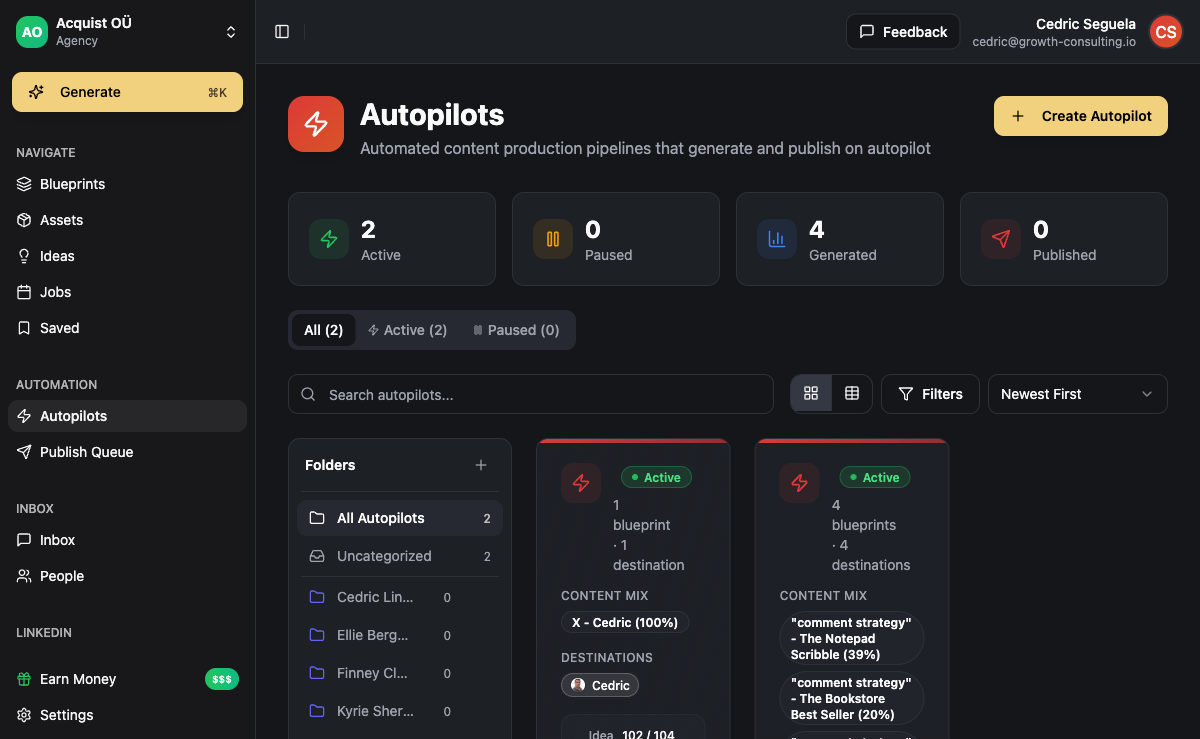
ACA is built specifically for this use case: multi-channel outreach (LinkedIn, email, WhatsApp, Instagram, Telegram, SMS), BYOK AI, white-label sub-accounts, and a unified inbox - all in one platform. It replaces the stack of SmartLead + HeyReach + Expandi + Buffer that most agencies were running in 2024, and cuts the monthly tool cost from $800-$1,300 down to one subscription.
See: AI Agency Tools: What You Actually Need in 2026.
What Results to Actually Expect
Specific results vary by niche, offer, and how well the system is configured. That said, here is what a well-built AI lead generation system typically delivers when it is set up correctly:
- Reply rate (cold outreach): 5-15% across channels with AI personalization. Generic templates sit at 1-3%.
- Positive reply rate: 1-4% of total touches result in a genuine sales conversation
- Meetings booked: From 500 monthly touches, 5-20 booked meetings is a reasonable range depending on niche and offer quality
- Time to first meeting: With AI qualification running 24/7, the gap between first reply and booked meeting shrinks from days to hours
The most common mistake agencies make is launching a technically correct system with the wrong offer. AI lead generation amplifies your outreach - it cannot fix a value proposition that does not resonate. If your message is not landing manually, the AI version will fail faster and at higher volume.
Spend time on the offer before you scale the system. Test manually with 50 contacts. If you are getting replies and conversations, turn on the full automation. If you are getting silence, refine the message first.
Related: How to Get AI Agency Clients: A No-BS Guide.
FAQ
What is the difference between AI lead generation and traditional lead generation?
Traditional lead generation relies on manual research, human-written emails, and follow-up driven by individual reps. AI lead generation automates targeting, outreach, personalization, and qualification - allowing one person or agency to manage 10x the volume with better conversion rates. The AI does not just speed up the old process; it replaces entire steps of it.
Is AI lead generation compliant with GDPR and CAN-SPAM?
Compliance depends on how you use it, not the technology itself. For email outreach, CAN-SPAM requires a clear unsubscribe mechanism and accurate sender information. GDPR adds requirements around data storage and consent for EU-based prospects. Any serious AI lead generation platform should provide unsubscribe management and data handling that meets these standards. Always consult legal counsel for your specific situation and target geography.
How many leads do I need to start an AI lead generation campaign?
You can start with as few as 100-200 carefully targeted leads to validate your offer and messaging. Once you confirm that your message is getting replies at a rate that makes sense, scale up. Starting with 10,000 untested leads is the fastest way to burn your domain reputation and waste three months.
What industries work best for AI lead generation?
B2B industries with a defined buyer (a specific job title at a specific company size) respond best: SaaS, professional services (accounting, law, consulting), recruiting, real estate commercial, financial services, and agencies. Consumer businesses or highly regulated industries (pharma, healthcare) have different compliance requirements and often see lower performance from cold outreach channels.
Can small agencies run AI lead generation for multiple clients?
Yes - this is exactly the use case platforms like ACA are built for. Each client runs in a separate workspace with their own ICP scoring, campaign sequences, and brand voice. One person managing 10 client accounts is realistic with the right platform. The limit is not technical - it is how much time you want to spend on strategy and optimization per account per month.