AI social media automation in 2026 is the combination of content generation, brand-voice training, ICP-aware writing, and platform-native publishing. A scheduler alone is not automation. It is a queue. If you still have to write every post, design every carousel, and adapt every caption by hand, the scheduler did not automate anything. It just moved the bottleneck from publishing to production. Real automation produces the content too.
AI social media automation is a system that generates on-brand content (posts, carousels, videos, captions), adapts it to each platform's native format, and publishes on a schedule without a human writing every piece. It differs from a social media scheduler, which only handles the publishing step and still requires manual content creation upstream.
The Scheduler Trap: Why Buffer and Hootsuite Are Half a Tool
Most people who say they have "automated their social media" mean they bought Buffer, Hootsuite, or Later, queued up 30 posts on Sunday evening, and called it a day. That is not automation. That is batch publishing. The work moved from Monday morning to Sunday night. The total hours did not decrease. They just compressed.
Schedulers solve one problem: "how do I publish this post on Tuesday at 9 AM without being at my desk?" That is a real problem. It is also a small problem compared to the actual work: writing the post, designing the carousel, picking the hook, adapting the caption for LinkedIn vs Instagram, finding the right hashtags, and producing enough of all of it to stay consistent for 12 months.
If you run an agency and you are selling "social media management" with a scheduler as your core tool, your delivery cost is whatever you pay a copywriter and a designer plus the scheduler license. The scheduler is the cheap part. The humans are the expensive part. That is why most social media agencies have terrible margins.
The 2026 stack flips this. The content generation is the platform. The scheduling is a feature inside it. Production runs on autopilot. Humans review, not write.
What Real AI Social Media Automation Actually Includes
To replace the human production layer, the system has to do four things well. Most tools do one of them. A few do two. Almost none do all four.
Brand voice training that survives the first draft
Generic ChatGPT output reads like ChatGPT. Anyone who has spent ten minutes on LinkedIn can spot a raw prompt-and-paste post in the first sentence. Real brand voice training means the system has read your past posts, your tone calibration documents, your forbidden phrases, the way you punctuate, the topics you avoid, and the angle you take on the topics you cover.
The output should be indistinguishable from something you would write yourself on a good day. If you have to rewrite every post the AI gives you, the AI did not save you time. It just gave you a worse first draft than the one you would have started with.
Characters: multiple voices inside the same brand
If you run an agency, you have many clients. Each one has a different voice. If you have a personal brand and a company brand, those are two voices. If you have a founder account and a product account, two more. A serious automation system holds each character separately, with its own training data, its own tone, its own topic library. Switching from one to another is a dropdown, not a re-prompt.
Most tools cannot do this cleanly. They either dump everything into one workspace and bleed voices, or force you to spin up a separate account per character at a separate cost.
ICP-aware content, not topic-aware content
Topic-aware content is "write a post about email deliverability." ICP-aware content is "write a post about email deliverability that a head of growth at a 50-person B2B SaaS would stop scrolling for, in the voice of a founder who has run 10,000-prospect campaigns." The first one is generic. The second one is a piece of content your buyer actually reads.
The system needs to know who you sell to, what they care about, what objections they hold, what language they use internally. That is ICP context. Without it, you are publishing a thought-leadership Mad Libs that nobody outside your team finds interesting.
Platform-native output, not cross-posted clones
This is the single most-violated rule on social media in 2026. A LinkedIn post is not an Instagram caption. A Twitter thread is not a TikTok script. A YouTube short is not a 10-second IG reel. Each platform has its own length, its own opening hook conventions, its own hashtag culture, its own punctuation norms, and its own algorithmic preferences.
Cross-posting the same text to all platforms is the digital equivalent of wearing a tuxedo to the beach. Real automation generates a platform-native variant per channel from the same source idea. Same message, different shape.
Use a scheduler alone when: you are a single creator, you genuinely enjoy writing every post, your volume is under 10 posts per week, and your only problem is timing.
Use full AI social media automation when: you run an agency with multiple clients, you have more than one brand to manage, you publish across three or more platforms, or you need to scale output past what one human can write.
GEO and Platform Variants: The Difference Between Cross-Posting and Adapting
Generative engine optimization (GEO) is the new layer on top of platform-native output. AI engines (ChatGPT, Perplexity, Google AI Overviews) now read social content as a citation source for queries like "who is the best agency for X" or "what tools do founders use for Y." The way you write a post influences whether you get cited.
This means the content system has to think about three audiences per post:
- The human scroller who decides in two seconds whether to stop reading.
- The platform algorithm that decides whether to show your post to more people based on early engagement signals.
- The AI engine that crawls or ingests social content and decides whether to cite you when its user asks a related question months later.
A platform-native variant for each channel, written with GEO-friendly structure (clear claims, scannable lists, specific examples), gets all three. A cross-posted blob of identical text gets none of them.
The Three Pieces You Actually Need
Strip everything down. There are three components in a working AI social media automation system. If any of them are missing, you are back to manual work.
- Generation layer. AI that produces posts, carousels, captions, video scripts on brand and on ICP. Trained on your voice. Aware of your characters. Capable of platform-native variants.
- Review and approval layer. A queue where you (or your client) sees the drafts, edits if needed, and approves. This is the only step that needs human judgment. If the generation layer is good, this takes minutes per week, not hours per day.
- Publishing layer. The scheduler. The thing that puts the approved content live at the right time on the right platform. This is the commodity layer. It is what people mistake for the whole product.
The mistake the social media industry made for ten years was selling layer 3 (publishing) as if it were the whole system. The result is a generation of operators who own a scheduler subscription and still write every post by hand.
What This Looks Like in Practice With ACA
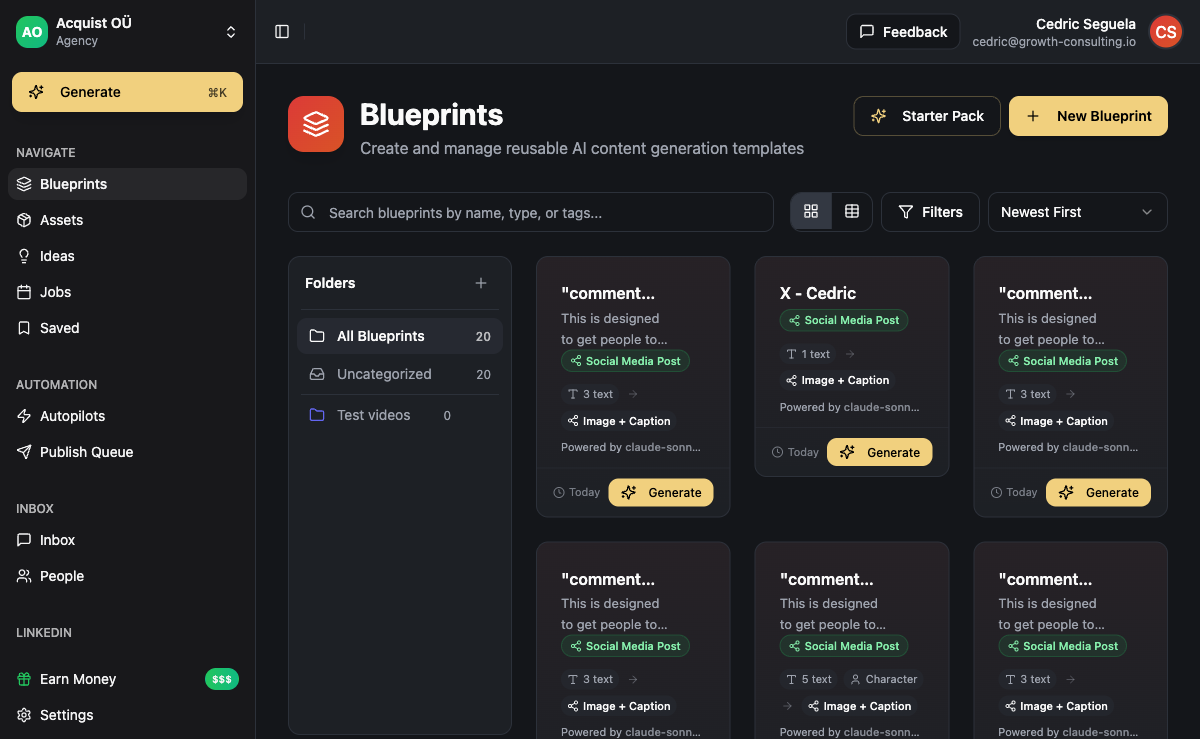
ACA was built as a content engine first and a scheduler second. The Blueprints module is where you define your characters, train your brand voices, set up topic libraries, and create reusable AI content templates. Once a blueprint is set, it generates on-brand posts, carousels, newsletters, and video scripts without further prompting.
The Autopilots module runs the generation and publishing on a schedule. You set it up once. It produces content, holds it in a review queue, and publishes the approved pieces to LinkedIn, Instagram, Twitter, and other connected channels at the times you choose. Each client (for agencies) gets their own isolated workspace with their own characters and their own publishing calendar.
The platform-native variant generation is built into the blueprints. Same source idea, different shape per platform. The ICP context is set per workspace. The brand voice is trained on whatever past content you upload. The output goes through the review queue before anything goes live.
The net result: the work shifts from "write 30 posts a week per client" to "review 30 posts a week per client." Most agency operators we have worked with cut their weekly content production time from 20+ hours to under 3.
When a Scheduler Alone Is Enough
To be fair, there are still cases where a plain scheduler is the right tool. If you are a solo creator who writes every post personally because writing is part of your craft, a scheduler is fine. If you publish under 10 posts per week across one or two channels and the writing is not a bottleneck, a scheduler is fine. If your brand voice is so specific that you would not trust an AI to produce a first draft, a scheduler is fine.
What stops being fine is the moment you scale. The second client. The third platform. The decision to publish daily instead of three times a week. The day you realize you have spent the entire Sunday writing posts for the week ahead and you are tired of it. At that point, a scheduler stops being enough, and the question is whether you hire humans or use a system that produces the content for you.
Frequently Asked Questions
Is AI social media automation the same as a social media scheduler?
No. A scheduler only handles publishing - putting content live at a specific time. AI social media automation includes content generation, brand voice training, ICP-aware writing, and platform-native variant creation, with scheduling as one feature inside a larger system. Calling a scheduler "automation" is like calling a printer a publishing house.
Will AI-generated social posts sound generic?
They will if you use a raw prompt with no brand voice training. They will not if the system is trained on your past content, your tone calibration, your topic library, and your ICP context. The difference between a generic AI post and a brand-native one is the depth of training data the system has, not the model itself. Most teams that complain about generic output skipped the training step.
How many platforms can one AI automation system handle at once?
Any system worth using should handle the major platforms (LinkedIn, Instagram, Twitter/X, Facebook, YouTube, TikTok) with platform-native variants per channel. The key is whether the system writes one post and copies it across, or whether it adapts each variant to the platform's native length, format, and tone. Cross-posting the same text is not the same as multi-platform automation.
Can I run multiple brand voices in the same automation system?
You should be able to. If you run an agency or manage multiple brands, the system needs character or workspace separation - each brand with its own training data, voice, ICP context, and publishing calendar. Tools that force you to either bleed voices in one workspace or pay for separate accounts per brand are not built for multi-brand operators.
Does AI-generated content hurt my reach on LinkedIn or Instagram?
Platform algorithms do not penalize AI-generated content directly. They penalize low-quality content, low engagement, and content that violates platform guidelines. If your AI output is on-brand, valuable to your audience, and gets normal engagement signals, the algorithm treats it the same as human-written content. The reach problem comes from posting bad content, not from posting AI content.
What is GEO and why does it matter for social media in 2026?
GEO (generative engine optimization) is the practice of writing content in a way that AI engines like ChatGPT, Perplexity, and Google AI Overviews can extract and cite. Social posts with clear claims, specific examples, and scannable structure get pulled into AI answers when users ask related questions. Cross-posted generic blobs do not. In 2026, your social content has three audiences - humans, platform algorithms, and AI engines - and GEO is what makes you visible to the third.