B2B lead generation is the process of identifying companies that match your ideal buyer profile, reaching them across the right channels with the right message, and converting interest into booked meetings. The founders who win in 2026 do not chase leads through one channel and pray. They run a 7-step system: define ICP, build a clean list, pick a channel mix, write the content, sequence the touches, measure the right metrics, and iterate weekly.
Short answer: To do B2B lead generation as a founder, follow seven steps in order. Define your ICP narrowly. Build a small, accurate lead list. Run multi-channel outreach (LinkedIn plus email at minimum). Write content that earns a reply, not impresses you. Sequence 5 to 8 touches across 3 to 4 weeks. Measure reply rate and meetings booked, not opens. Iterate every Friday based on what the data shows. Skip any step and the system breaks.
Step 1: Define Your ICP (Narrowly)
Most founders' ICPs are too vague to act on. "B2B SaaS founders" is not an ICP. It is a vague hope. A real ICP is specific enough that you could point at a company and say yes or no in under five seconds.
ICP (Ideal Customer Profile) is a written description of the exact type of company most likely to buy from you, close fast, get value, and stay. It includes industry, company size, geography, tech stack or operational signals, and the buyer persona inside that company. ICP is about the account. Persona is about the human.
Write your ICP with these five filters:
- Industry vertical: not "tech" - specifically "B2B SaaS companies selling to mid-market HR teams"
- Headcount range: a tight band like 20 to 80 employees, not "SMB to enterprise"
- Geography: the specific markets you can serve well (timezone, language, regulatory)
- Triggers: a recent event that suggests they need you now (hired a head of sales, raised a Series A, launched in a new market)
- Buyer persona: the exact job title with budget authority for what you sell
If your ICP description fits on one line, it is too broad. If it takes a paragraph, you are on the right track. Test it: pull 20 companies that fit your written ICP and 20 that do not. If a stranger reading your ICP cannot sort the 40 companies correctly, the ICP is too vague.
Step 2: Build a Clean Lead List
The single biggest reason cold outreach campaigns fail is bad data. You can have a perfect ICP, perfect message, perfect sequence, and still get nothing if your list is 30% wrong job titles, 15% bounced emails, and 10% people who left the company six months ago.
Build your list in this order:
- Source companies first, not contacts. Use a database (Apollo, Apify B2B Lead Finder, LinkedIn Sales Navigator) and filter on your ICP criteria. Aim for 200 to 500 target accounts to start, not 10,000.
- Find the right person at each company. Match the buyer persona exactly. "Marketing" is not a title. "Head of Demand Generation" is.
- Enrich the contact. Pull their LinkedIn URL, work email, and a verifiable trigger (recent post, hiring activity, funding event).
- Verify the email. Use a verification tool to remove invalid addresses before you send. Hard bounces above 2% destroy your sender reputation.
The mistake to avoid: buying a 50,000-row "B2B leads" list from a sketchy vendor. Those lists are full of spam traps that instantly blacklist your domain. Build smaller and cleaner. A 300-row list of perfect-fit accounts will outperform a 30,000-row list of noise every time.
Step 3: Pick Your Channel Mix
Single-channel outreach is dead in 2026. Inboxes are saturated. LinkedIn message limits are tight. WhatsApp is reaching B2B buyers in regions where email is ignored. The founders winning today run 2 to 4 channels in coordinated sequences.
Use LinkedIn + email if: your buyers are active on LinkedIn (most B2B software, services, consulting). This is the default mix for 80% of founders.
Add WhatsApp if: you sell to LATAM, MENA, India, or SEA - regions where WhatsApp is the dominant business channel.
Add Instagram DMs if: you sell to coaches, creators, agencies, or D2C founders who live on Instagram.
Skip phone calls unless: you sell a high-ticket product (10K+ ACV) where the unit economics support a dialing team.
Coordination matters more than channel count. Do not connect on LinkedIn and email the same person on the same day - that looks like spam. Stagger the touches: LinkedIn view on day 1, connection request on day 3, email on day 5, LinkedIn message on day 8, and so on. The prospect sees a coordinated set of relevant touches, not a swarm.
Step 4: Write Content That Earns a Reply
Cold outreach copy is not marketing copy. It is direct response. The single job of a cold message is to start a conversation, not to explain your product.
The 4-part structure that works in 2026:
- Trigger (1 sentence): a specific reason you are reaching out to this person, not the world. "Saw your post on hiring SDRs without managers - the pain you described is exactly what we solve."
- Relevance (1-2 sentences): a quick connection between their situation and what you do. No company pitch. No claims you cannot back up.
- Specific ask (1 sentence): a low-friction next step. "Open to a 15-minute call next Tuesday?" beats "Would love to chat sometime!"
- Sign-off: first name. No 5-line email signature with quotes and logos.
Keep cold emails between 50 and 125 words. LinkedIn messages should be even shorter (under 75 words). The biggest mistake founders make is writing 300-word emails that describe their company. Nobody reads those.
Personalization at the first-line level beats heavy templating. AI can write a custom opener for every prospect based on their LinkedIn activity, role, or company news. That single line lifts reply rates significantly compared to generic openers.
Step 5: Build a Multi-Touch Sequence
One-and-done outreach loses. The data is clear: most replies come from touch 3, 4, or 5, not the first message. Founders who stop after one or two touches are leaving the majority of their conversion volume on the table.
A solid B2B sequence for a 4-week window:
- Day 1: LinkedIn profile view + connection request (no note, or a 1-line contextual note)
- Day 3: First cold email - trigger, relevance, ask
- Day 6: LinkedIn message if connected, otherwise follow-up email with a different angle
- Day 10: Email follow-up with a piece of value (case study, short insight, useful resource)
- Day 15: Cross-channel touch (WhatsApp if appropriate, or a softer LinkedIn message)
- Day 22: Breakup email - "Should I close the loop here?"
- Day 30: Final LinkedIn touch with a different value angle
Each touch must add value or context, not just repeat the ask. Bumping someone five times with "just following up" trains them to ignore you.
Step 6: Measure the Right Metrics
Most founders watch the wrong dashboard. Open rates are now nearly meaningless because of Apple Mail Privacy Protection and similar features that inflate them artificially. Click rates matter only for funnels that depend on clicks. The metrics that actually predict revenue are further down the funnel.
B2B outbound benchmarks (in our experience working with agencies and founders): a well-targeted cold email campaign should produce a 5 to 15 percent reply rate. A well-run LinkedIn outreach campaign should produce 15 to 30 percent connection acceptance and 8 to 20 percent reply rate on accepted connections. Meeting-booked rate from total prospects contacted typically lands between 1 and 4 percent for sequences targeting a tight ICP. Below 1 percent usually means a targeting or copy problem, not a volume problem.
Track these metrics weekly:
- Reply rate (positive + neutral + negative): the cleanest signal of whether your message resonates
- Positive reply rate: replies that want to continue the conversation, not auto-responders or "unsubscribe"
- Meetings booked: the actual outcome you are paying for
- Show-up rate: how many booked meetings actually happen
- Cost per meeting: total cost of the campaign divided by meetings that happened
- Pipeline created: dollar value of opportunities that came from booked meetings
Stop watching open rates. Start watching positive reply rate and cost per meeting. Those are the two numbers that tell you whether the system is working.
Step 7: Iterate Every Week
B2B lead generation is not set-and-forget. It is a weekly tuning loop. The campaigns that look incredible in month six started ugly in month one and got better through 20+ iterations.
Run a 30-minute Friday review on these questions:
- What had the highest positive reply rate this week? Double down on that angle, that segment, that subject line.
- What had the lowest? Kill it or rewrite it. Do not keep running things because you wrote them.
- Where in the sequence are people dropping off? If touch 3 has half the engagement of touch 1, rewrite touch 3.
- Are you booking meetings that close? If yes, scale the segments those meetings came from. If no, your ICP is wrong - go back to step 1.
The founders who win at outbound treat it like a product. Small experiments, fast feedback, weekly improvements. Compound those tweaks over 12 months and the system that was producing 5 meetings a month is now producing 50.
Common Mistakes Founders Make
- Going too broad: trying to reach every plausible buyer instead of the 200 best-fit accounts
- Sending without warm-up: blasting cold emails from a new domain and getting blacklisted in week one
- Personalizing the wrong things: spending an hour researching every prospect manually instead of letting AI handle first-line personalization at scale
- Stopping after two touches: most replies come from touches 3 through 7
- Watching opens instead of replies: opens are vanity, replies are pipeline
- Pitching the product in message one: the first message earns the conversation, not the sale
- Running channels separately: uncoordinated multi-channel feels like spam, coordinated multi-channel feels like persistence
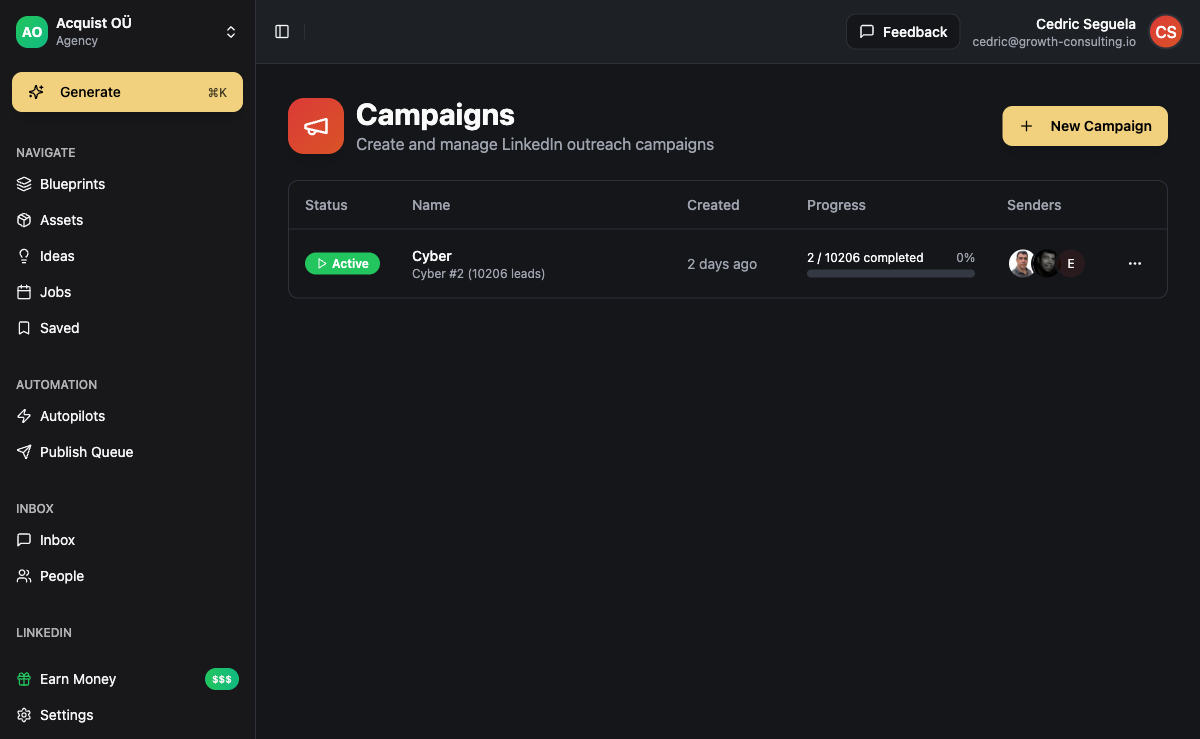
The fix for all seven mistakes is the same: pick a platform that runs the full system in one place. ACA consolidates multi-channel sequences, lead sourcing through Apify, AI-personalized content, unified inbox, and reporting under one roof. You stop stitching together six tools and start tuning one system.
Frequently Asked Questions
How long does it take to see results from B2B lead generation?
First responses typically come within 7 to 14 days of a campaign going live, assuming your domain is properly warmed and your list is clean. The first booked meeting usually lands in week 2 or 3. A campaign needs at least 4 to 6 weeks to produce reliable data on what is working. Anyone promising overnight results is selling you a story, not a system.
How many leads do I need to contact to book a meeting?
For a well-targeted B2B sequence, expect to contact 30 to 100 prospects to book one meeting. The ratio depends heavily on ICP fit, message quality, and channel mix. Tight ICP plus multi-channel touches plus strong copy can push that ratio under 30. Loose ICP plus single-channel plus generic copy can blow it past 200. Optimize the ICP and message before you optimize volume.
Should I do B2B lead generation myself or hire an agency?
If you have under 10 hours a week to spend on outbound, hire an agency or use a platform that automates the heavy lifting. If you are pre-product-market-fit, you should run it yourself for the first 3 to 6 months - the conversations you have with prospects teach you what your product should become. Founders who outsource outbound too early miss the learning that only comes from being in the inbox.
What is the best channel for B2B lead generation in 2026?
There is no single best channel - the winning answer is multi-channel. LinkedIn plus email is the default mix for most B2B founders. Add WhatsApp if you sell internationally to regions where it dominates. Add Instagram DMs if you sell to coaches, agencies, or creators. The channel mix should match where your buyer actually lives, not where you find it easiest to send messages.
How much should I budget for B2B lead generation as a founder?
At minimum, budget for: a domain plus mailbox setup ($50 to $100/mo), a sending and sequencing platform ($50 to $300/mo depending on the tool), lead data costs ($50 to $200/mo for sourcing), and your time or an SDR. A founder running their own outbound with the right stack can produce real pipeline for under $400/mo in tooling. Outsourced full-service agencies typically charge $2,500 to $7,500/mo for managed B2B outbound.
Is cold email still legal for B2B in 2026?
Yes, in most jurisdictions, when done correctly. In the US under CAN-SPAM, B2B cold email is legal if it includes accurate sender identification, a physical address, and a working opt-out mechanism. In the EU under GDPR, B2B cold email is legal under "legitimate interest" provided you contact business contacts at business addresses for purposes relevant to their role, and you honor opt-outs immediately. Consumer (B2C) rules are stricter - this guide covers B2B only.