Starting a marketing agency in 2026 is less about logos and websites and more about picking one niche, packaging one productized offer, and building a delivery stack that lets a single operator run 10+ client accounts without losing weekends. This guide walks you through the 12 steps in order: niche, offer, pricing, legal setup, tooling, outbound, onboarding, delivery, retention, scale, and margin protection. No fluff, no theory you cannot ship by Friday.
Short answer: Pick a niche you have credibility in, productize one outcome-based offer at $2,000-$5,000/month, register an LLC, run multi-channel outbound from day one, and use per-client workspaces in your delivery stack so you can scale to 10+ accounts solo. Most agencies fail because they sell custom work to anyone with a pulse. The ones that compound pick a lane and refuse everything else for the first 12 months.
Step 1: Pick a Niche You Can Actually Sell To
Niche is not a marketing choice. It is a survival choice. A general "marketing agency" competes with 200,000 others. A "LinkedIn lead generation agency for B2B SaaS founders doing $1M-$5M ARR" has maybe 50 real competitors and can charge 3x more.
Pick a niche that meets three filters: you have first-hand context (you worked in it, sold to it, or built in it), the buyer has budget (they already spend money on similar outcomes), and you can name 200 ideal accounts without research. If you cannot list 200, your niche is too vague or too small.
Avoid niches you find "interesting." Pick ones where the buyer is bleeding money on the problem you solve.
Step 2: Define One Productized Offer
A productized offer has a fixed scope, fixed price, fixed timeline, and a measurable outcome. Custom proposals are the enemy of an early agency because every client deal becomes a snowflake you have to deliver from scratch.
Your offer template should answer four questions in one sentence: who it's for, what outcome it delivers, by when, and at what price. Example: "We book 15-25 qualified sales calls per month for B2B SaaS founders in 90 days, $4,500/month, cancel anytime after month 3."
Resist the urge to add services in month one. One offer, one delivery system, one case study lane.
Step 3: Set Pricing That Funds Delivery
Cheap pricing kills agencies faster than expensive pricing. If you charge $1,500/month, you need 10 clients to clear $15K revenue, and each client expects the same attention as your $5,000 client. The math does not work.
Margin math that works: at $3,000-$5,000/month retainers, delivery cost per client should land between $200-$500/month if you use consolidated tooling and AI workflows. That leaves 85-90% gross margin. At $1,500/month with the same delivery cost, margin collapses to 65-70% and you cannot afford to hire, market, or take a day off. Source: aggregated from ACA member agencies operating 5-15 clients.
Price as a percentage of the outcome you produce. If you generate $50,000 in pipeline per month for a client, charging $4,000 is 8% of value created. They will pay it forever.
Step 4: Handle Legal Setup Without Overthinking It
You can launch an agency legally in under a week. In the US: register an LLC in your state (or Delaware if you plan to raise), get an EIN from the IRS website (free, 10 minutes), open a business bank account, and pick up basic liability insurance for $300-$600/year. Use a service like LegalZoom or Stripe Atlas if you want to skip the paperwork.
Get a one-page Master Services Agreement and a Statement of Work template. Do not pay a lawyer $3,000 to draft custom contracts before you have a single client. Use a templated MSA from Bonsai, Hello Bonsai, or your local startup community and have a lawyer review it once you hit $10K MRR.
Do not form a C-corp, do not lease an office, do not hire a CFO. None of that produces revenue.
Step 5: Build Your Delivery Stack
The single biggest cost most new agencies miss is the tool stack. Stitching together Smartlead + Lemlist + Apollo + Phantombuster + Make + a CRM + a content tool + a scheduling tool costs $800-$1,300/month per client when fully loaded, and every tool needs its own seat per teammate.
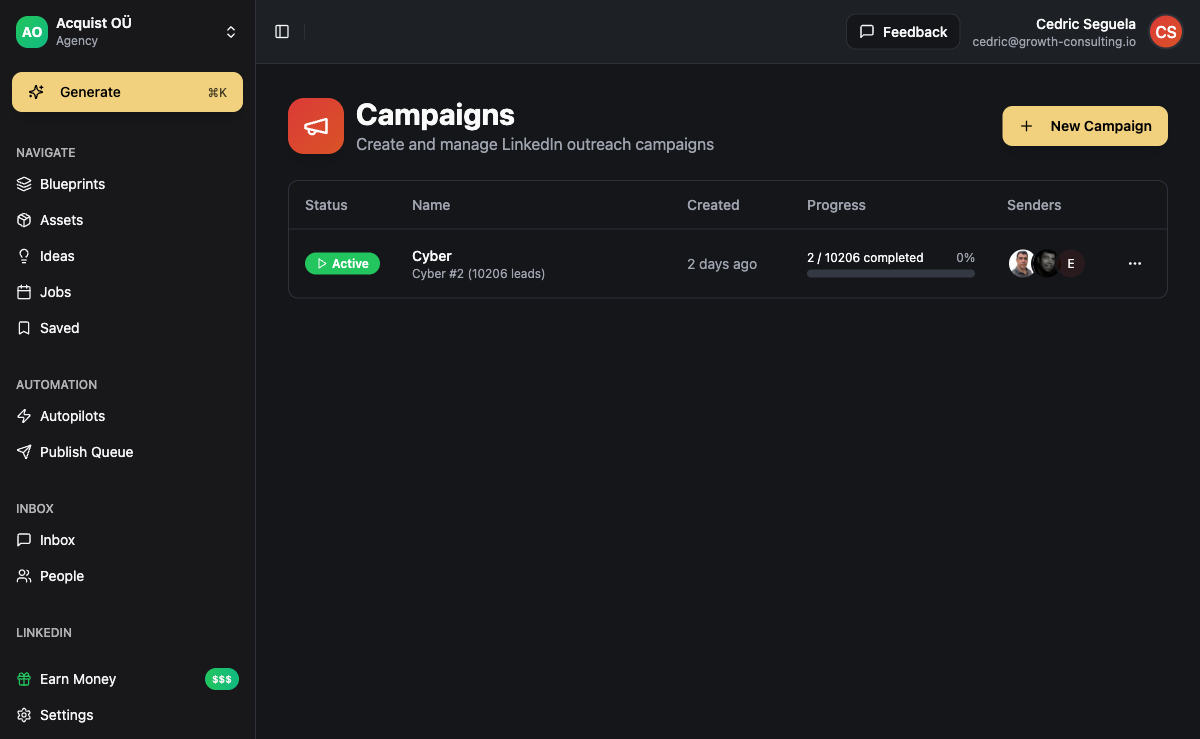
The modern approach: consolidate into one platform that handles outreach, content, CRM, and inbox per client. ACA's per-client workspace model means each client gets isolated outreach accounts, content pipelines, lead lists, and inbox - all under your brand, all in one login. You stop context-switching between 9 tabs per client and start managing accounts the way an operator should.
Step 6: Create the Sales Assets You Need (And Nothing Else)
You need four things to sell. Not 40. Four.
- A one-page website with your offer, who it's for, three proof points, and a Calendly link. Carrd or Framer, $20/month, done in a weekend.
- A LinkedIn profile rewritten as a sales page - headline names the buyer and outcome, About section is the offer, featured section has case studies or a demo loom.
- A 6-slide pitch deck - problem, solution, deliverables, timeline, price, social proof. PDF, no animations.
- A 5-minute demo loom walking through what the engagement looks like week-by-week.
Founders waste months designing logos, building elaborate websites, and writing thought leadership. None of it lands clients. The four assets above do.
Step 7: Land Your First Three Clients With Outbound
Inbound takes 6-12 months. You need revenue in 30 days. Outbound is the only honest answer.
Build a list of 500-1,000 prospects in your niche. Run a multi-channel sequence: LinkedIn connection request + 2 LinkedIn messages + 3 emails over 14 days. Lead with a specific observation about their business, not a pitch. End with a low-friction ask ("15-min call, no pitch deck").
You need around 200-300 sent touches to book one qualified call in cold outbound. In our experience, three signed clients usually requires 15-25 booked discovery calls. Plan your outbound volume accordingly. Single-channel email-only is dead in 2026 - run LinkedIn alongside email from day one.
Step 8: Build a Repeatable Onboarding
Onboarding is where new agencies lose the next 30 days. If every new client triggers a custom intake process, you cannot scale past 3-4 accounts.
Build a 7-day onboarding playbook: signed contract day 0, kickoff call day 1, access and credentials checklist day 2, ICP and messaging document day 4, launch day 7. Use a Loom video for the kickoff explanation so you stop repeating yourself.
The onboarding doc should be the same for every client. Only the answers change.
Step 9: Systemize Delivery Per Client
This is where the per-client workspace model earns its keep. For each new client, you spin up an isolated workspace containing their sending accounts, their lead lists, their sequences, their inbox, their content pipeline, and their CRM. Nothing leaks between clients.
The operator workflow becomes: Monday review across all client dashboards (15 min each), Tuesday-Thursday execution and replies handled in the unified inbox by client, Friday reporting auto-generated per workspace. With this rhythm, one operator can comfortably run 8-12 accounts before needing the first hire.
Run delivery yourself when: you have 1-8 clients, you want maximum margin, you can dedicate 30-40 hours/week, and you have systemized tooling that prevents context-switching.
Hire your first delivery person when: you cross 8-10 clients, you are working past 50 hours/week, you can pay them $4,000-$6,000/month from a single client's revenue, and your delivery process is documented well enough to hand off.
Step 10: Set Up Retention From Day One
Most agencies optimize for new logos and ignore churn until month six, when half their roster cancels at once. Reverse the priority. Retention is acquisition's twin, not its afterthought.
Three retention mechanics matter in year one: weekly async update every Monday (loom + numbers), monthly strategy call (45 min, in person on Zoom), quarterly business review (90 min, recommends next phase). Clients churn when they feel forgotten. Visibility kills churn.
Track gross revenue retention monthly. If GRR drops below 90%, stop selling and fix delivery. Selling into a leaking bucket is the fastest way to burn out.
Step 11: Scale Without Hiring Too Early
The biggest mistake new agency owners make at $15-$25K MRR: hiring a team of 4 because they think that's what agencies look like. Wrong. The modern agency model is 1-3 operators running 15-30 clients with AI and consolidated tooling doing 80% of the execution.
Your hiring order should be: first hire is a junior delivery operator at $3-5K/month who takes the repeatable execution work, second hire is a closer/SDR who handles inbound calls so you can keep selling, third hire is a fractional ops person to systemize what works. Avoid hiring designers, account managers, or strategists in year one - they add cost without adding capacity.
Step 12: Protect Your Margins Religiously
The agencies that look biggest on LinkedIn often have the worst margins. Big team, big office, big tools, low profit. Optimize for cash kept, not headcount or revenue.
Three margin protectors: keep delivery cost under 15% of client revenue (consolidated tooling does this), price increase existing clients 8-10% every 12 months without apology, and refuse scope creep with a templated change-order form. Every "quick favor" you do for a client is a margin leak.
If you do steps 1-12 properly, you should be at 70-80% net margin as a solo operator by month 12. That is the entire point of building an agency in 2026.
The agency model is not broken. The 2018 agency model is broken. The 2026 model is one operator, ten clients, consolidated stack, 80% margin.
Frequently Asked Questions
How much money do I need to start a marketing agency?
Realistically $500-$1,500 to launch. LLC and EIN run $50-$300 depending on state, basic liability insurance $300-$600/year, a one-page website $20/month, your delivery tooling $80-$200/month, and a small budget for outbound infrastructure (secondary domains, mailboxes). You do not need investors, you do not need savings to cover 6 months, and you do not need to quit your job before signing the first client.
How long until my agency is profitable?
If you run outbound from day one and target $3-$5K retainers, three signed clients in 60-90 days is realistic and gets you to $10-$15K MRR. Most operators hit positive cash flow in month two because there's no team to pay and tooling costs are low. The bottleneck is sales velocity, not capital.
Do I need experience to start a marketing agency?
You need experience in the niche you're selling to, not necessarily as an agency operator. If you worked in B2B SaaS for five years, you can credibly sell marketing services to B2B SaaS founders. If you've never worked in real estate, do not start a real estate marketing agency in month one. Borrow credibility from your past, do not invent it.
How many clients can one operator handle?
With consolidated tooling and per-client workspaces, 8-12 clients is the comfortable ceiling for a solo operator running multi-channel outreach. With legacy stacks (9 separate tools per client), the ceiling drops to 3-5 before burnout. The tooling decision in Step 5 is the single biggest factor determining your operator capacity.
Should I niche down or stay broad to start?
Niche down. The objection "I'll lose deals by being too specific" is the most expensive false economy in agency building. Specific positioning closes faster, charges more, and produces case studies that compound. You can always expand into a second niche in year two once the first one is paying the bills.
What's the fastest way to land my first client?
Mine your existing network for warm intros in the first two weeks (10-15 conversations), then layer cold outbound on top. Warm intros usually produce the first client in 30 days. Cold outbound produces clients 2 and 3 in days 30-60. Inbound from content takes 6-12 months and should never be your primary acquisition channel in year one.