A white-label social media tool lets you sell content production and social media management under your own brand while a platform like ACA runs the actual delivery. You get a custom domain, your logo, isolated client workspaces, and reseller pricing. Clients log into your branded portal and never see the underlying software. This is how solo operators run social media agencies pulling $20K to $50K per month without hiring content teams or building software from scratch.
Short answer: A white-label social media tool is a platform you resell under your own brand. You set the price, control the client relationship, and ship branded portals on your domain. The platform handles content generation, scheduling, approvals, and reporting in the background. ACA's white-label adds custom domains, isolated client orgs, BYOK economics, and AI content pipelines (posts, carousels, newsletters, videos) so you can run a full SMM agency with a stack cost under $100 per client per month.
What Is a White-Label Social Media Tool?
A white-label social media tool is a software platform built so you can resell it as if you built it yourself. The vendor stays invisible. Your logo sits on the login screen. Your domain appears in the browser bar. Your support email handles tickets. Your pricing decides what clients pay.
This is different from agency mode in most SaaS tools, which usually just means "manage multiple client accounts from one dashboard." Real white-label means three things working together:
- Brand control: custom domain, custom logo, custom colors, no third-party branding visible to your clients anywhere in the product.
- Tenant isolation: each client gets their own workspace with their own data, brand assets, and team members. Nothing crosses between clients.
- Reseller economics: you pay a flat platform fee or BYOK costs and charge clients whatever the market will bear. The vendor does not see or touch your pricing.
If a tool advertises "white-label" but loads your client's dashboard on the vendor's domain or shows the vendor's logo somewhere in the UI, that is co-branding, not white-label. Walk away.
Why SMM Agencies Specifically Need White-Label
Social media management has one of the worst client-retention problems in agencies. Clients see the tools you use, the scheduler you log into, the reports the dashboard exports. Within six months they realize they could buy Buffer for $20 a month and do it themselves. They cancel.
White-label fixes this by hiding the supply chain. Your clients log into your platform. They see your content calendar, your approval flows, your reporting. They are not buying tool access. They are buying your brand, your strategy, and your output. That distinction is worth thousands per month per client.
The retention shift: in our experience working with agency owners, switching from a transparent SaaS stack to a white-labeled portal moves average client lifetime from roughly 4-6 months to 12-18 months. The client cannot easily replace what they cannot identify.
There is a second reason that matters more for solo operators: pricing power. When clients can see you are using Hootsuite plus Canva plus ChatGPT, they mentally calculate the tool cost and try to negotiate your fee down to "reasonable markup." When they see a branded portal, the comparison disappears. They pay for the outcome.
Core Features a White-Label SMM Tool Must Have
Not all white-label platforms ship the same surface area. Here is the feature checklist that separates a real reseller platform from a co-branded scheduling tool.
| Feature | Why it matters | Red flag if missing |
|---|---|---|
| Custom domain (CNAME) | Clients log in at app.youragency.com, not vendor.com/your-name | Vendor domain visible = not real white-label |
| Custom logo and favicon | Appears on login, dashboard, emails, exports | Vendor logo anywhere in product |
| Custom email sender | Notifications come from your domain, not the vendor | Clients get emails from a vendor address |
| Isolated client workspaces | Brand assets, content, and team members stay separate per client | Shared data pools across clients |
| Team and role management per workspace | Client team logs in to their workspace only | Clients see other clients' data |
| Content production pipeline | AI generates posts, carousels, videos at scale | Just scheduling = not enough margin |
| Approval workflows | Clients review and approve before publish | You manually screenshot and email drafts |
| Branded reporting | PDFs and dashboards export with your logo | Reports show vendor branding |
| Reseller pricing model | Flat or BYOK cost so you control margins | Per-client license fees eating your profit |
If a platform ticks the first three boxes but fails on the rest, you have a branded login screen wrapped around a tool clients can still figure out. Real white-label covers the full client experience end to end.
How ACA's White-Label Works in Practice
ACA was built for agencies from the start, not retrofitted with a "white-label add-on" later. Here is the actual workflow you go through to ship a branded SMM agency on top of it.
Step 1: Custom domain setup
You point a CNAME from a subdomain of your agency domain (typically app.youragency.com or portal.youragency.com) to ACA's hosting. SSL provisions automatically. Within a few hours your branded URL is live. Clients who type your URL see your login screen, your colors, your logo. ACA does not appear anywhere.
Step 2: Brand configuration
In a single settings panel you upload your logo (used on login, sidebar, exports, emails), set your primary brand color (drives buttons, accents, highlights across the entire UI), set your favicon, and configure the support email address clients should reach you at. Notification emails go out from your domain via your SMTP credentials.
Step 3: Spin up isolated client orgs
Each client gets their own organization inside the platform. This is not a tag or a label. It is a hard data boundary. The client's brand voice profile, content library, scheduled posts, social account connections, team members, and reporting data all live inside their org. Switch organizations in your top-left selector and the entire app context changes.
You as the agency owner can sit at the top level and see all orgs in one view. Team members can be assigned to specific orgs or to all orgs based on the role you give them. Clients only ever see their own org.
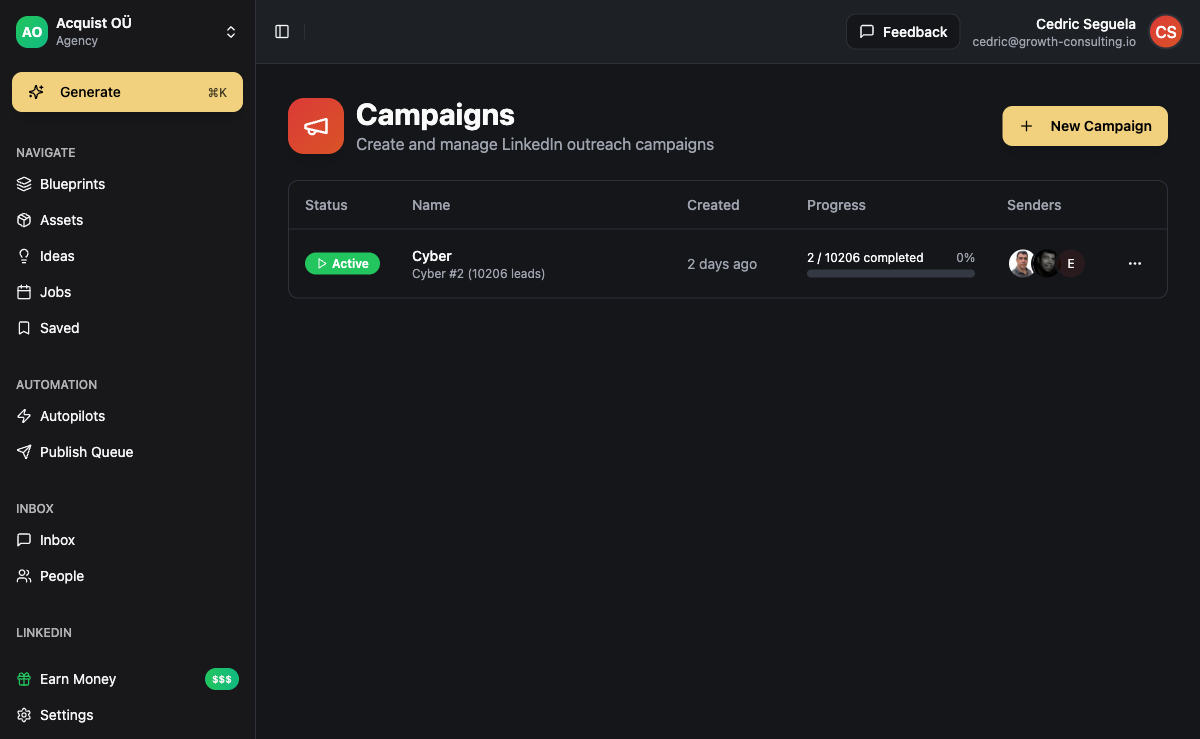
Step 4: Configure AI content pipelines per client
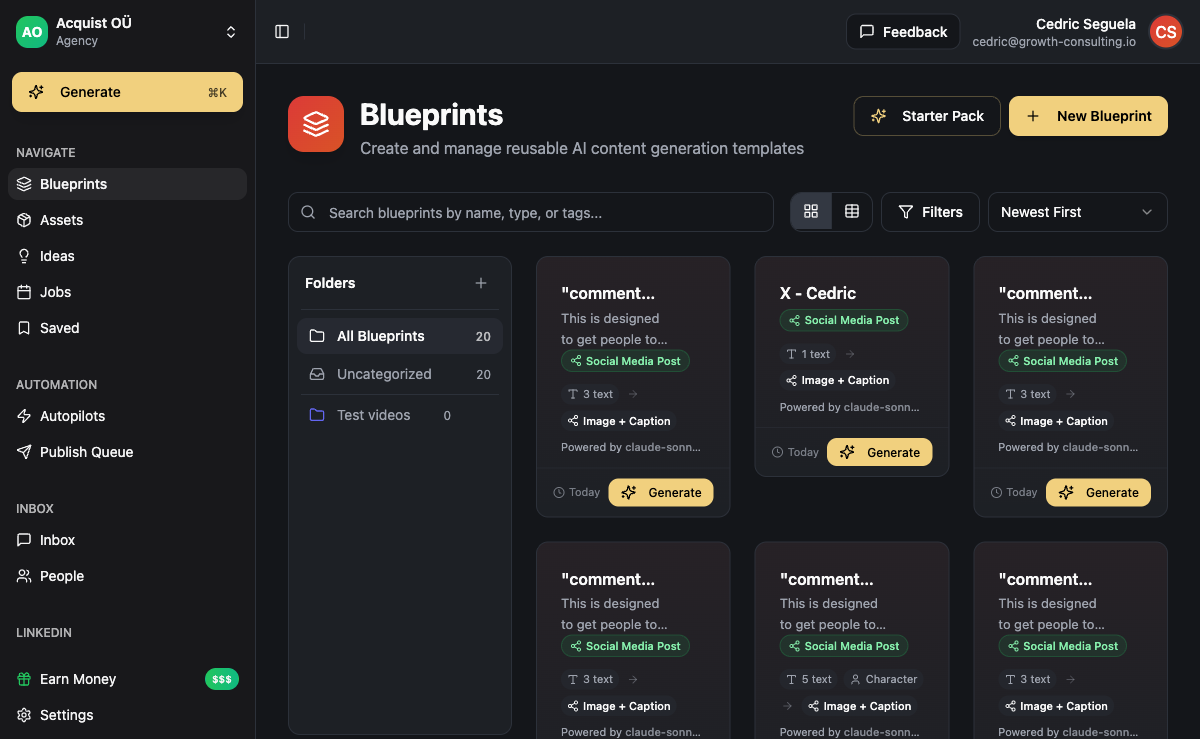
This is where ACA stops being a scheduling tool and starts being an SMM agency in a box. Inside each client org you define their brand voice (tone, style, banned phrases, examples of good content), their content blueprints (the recurring content formats they need - thought leadership posts, carousel breakdowns, founder stories, newsletters), and their cadence (how many of each format per week, on which channels).
ACA's Autopilot runs the pipelines automatically. Content gets generated on schedule, queued for your review, then routed to the client's approval workflow if they want final say. Approved posts publish to their connected LinkedIn, Instagram, Twitter, Facebook, and other channels at the times you set.
Step 5: Branded approval and reporting
Clients log into your branded portal to review upcoming content, request edits, and approve or reject posts. The interface they see has your logo, your colors, your URL. They can leave comments, suggest changes, and approve in bulk. Reports they receive (weekly, monthly, or on demand) export with your branding for them to forward internally.
Isolated client org means each client's data, brand configuration, team members, and content history live in a separate logical tenant inside the platform. Switching from Client A's org to Client B's org changes the entire app context. There is no scenario where one client can see, access, or be affected by another client's data. This is the core technical requirement that makes a white-label tool safe to resell at scale.
The Reseller Pricing Model and Real Economics
The economics of a white-label SMM agency only work if your cost structure stays flat as you add clients. Per-seat or per-client licensing eats margin and caps your scale. Two pricing models actually work for resellers:
- Flat platform fee: you pay one monthly fee and add unlimited clients on top. Most legitimate white-label platforms work this way.
- BYOK (Bring Your Own Key): you bring your own AI API keys (OpenAI, Anthropic, image and video model providers) and pay actual usage cost instead of marked-up SaaS pricing. Platform fee stays minimal.
ACA uses BYOK. Your AI usage cost per client typically runs $10 to $30 per month depending on content volume and channels. Platform cost is flat. That puts your total delivery cost per client somewhere in the $40 to $100 range.
The margin math: a typical SMM agency retainer for a small business runs $1,500 to $3,500 per month. With delivery cost under $100 per client, gross margin sits at 90%+. Even at $800/month entry-level retainers your margin holds above 85%. This is what makes the model run for solo operators - you do not need a team to scale to $20K per month MRR.
What clients actually pay for
The mistake new agency owners make is pricing on "hours of work." The work takes you 2 hours per client per week once your blueprints are configured. If you price by the hour your retainers come out to $400 a month and you starve.
Price on outcomes. Clients are buying consistent on-brand content at a volume they cannot produce internally, posted on a schedule they cannot maintain, with reporting they can show their boss. That is a $2,000 to $5,000 problem depending on the client's size and the channels involved.
Price at $800-$1,500/mo when: client is a solopreneur or small business, single channel (usually LinkedIn or Instagram), 3-5 posts per week, light reporting.
Price at $1,500-$3,500/mo when: client is an SMB or mid-market, 2-3 channels, 8-15 posts per week plus a newsletter, monthly strategy calls.
Price at $3,500-$7,500/mo when: client needs multi-channel coverage (LinkedIn + Instagram + Twitter + newsletter), 20+ pieces of content per week, video repurposing, weekly performance reviews, dedicated content strategist.
Setting Up Your White-Label SMM Agency on ACA
Going from zero to a live branded portal with your first client onboarded takes a few hours of focused work. Here is the exact sequence.
Day 1: Brand and domain setup
- Buy your agency domain if you do not have one. A clean .com is worth the extra cost for trust signals.
- Inside ACA, configure white-label settings: upload logo, set primary color, configure favicon, set support email.
- Point a CNAME from app.youragency.com to ACA's hosting target. Wait for DNS and SSL to propagate.
- Connect your sending email account for branded notifications.
- Log in via your branded URL and verify every screen shows your branding.
Day 2: Service productization
- Define 2-3 service tiers using the pricing framework above. Resist the urge to offer 7 packages.
- Build a content blueprint library for each tier. This is the set of recurring formats you will deliver: thought leadership posts, founder stories, industry breakdowns, carousels, newsletter, etc.
- Write a sample 30-day content calendar for one fake client. This becomes your sales demo.
- Create your onboarding form: client brand assets, voice samples, social account credentials, approval preferences.
Day 3: First client onboarding
- Create a new isolated client org inside your ACA workspace.
- Upload their brand voice samples and configure their content blueprints.
- Connect their social accounts to the org.
- Configure their cadence and approval flow.
- Generate the first 2 weeks of content, run it through approval, queue it for publish.
- Send them their branded login credentials so they can review going forward.
From here, each additional client takes roughly 60-90 minutes to onboard if their brand voice is well-defined. Two clients per week of new sales puts you at 8 clients in a month, which at $1,500 average is a $12K MRR business with delivery cost under $800.
Common White-Label Mistakes to Avoid
Most agencies that fail with white-label make the same handful of errors. Avoid them and the model works.
- Reselling a tool the client could just buy directly. If your only value is access to a scheduler, the client will figure it out. Wrap the tool in strategy, content production, and reporting they cannot replicate with an off-the-shelf product.
- Showing your tools in proposals. Never mention the underlying platform in sales calls, proposals, or onboarding. Clients are buying your service, not a software subscription. The moment you mention "we use ACA on the backend" you have just given them a search query.
- Letting clients into the agency-owner view. Some platforms expose admin features at certain URLs. Always test your client experience from a separate browser logged in as a client user. They should never see the cross-client switcher or admin panels.
- Charging like a freelancer. $500/month retainers do not work for SMM agencies because you still have client management overhead per account. Price at $1,500 minimum so each client is worth the relationship investment.
- Underestimating brand voice configuration. The first 2 hours of every client onboarding go into properly capturing their voice. Skip this and you ship generic content. Generic content gets you fired in 90 days. Spend the time upfront.
- Forgetting to white-label outbound emails. Notifications, approval requests, and report deliveries that come from a vendor email address blow your cover instantly. Configure the email sender domain on day one.
The agencies that win with white-label do not sell software access. They sell consistent output the client genuinely cannot produce themselves, delivered under a brand the client trusts. The tool is invisible. The result is the product.
When White-Label Is Not the Right Move
White-label is not for everyone. Skip it if:
- You have one or two clients you are personally close to. The branding overhead is not worth it for sub-$3K MRR.
- You are selling consulting or strategy as the core product, not content production. Consultants do not need branded portals.
- You want to scale past 50 clients with a team. At that point you should be evaluating whether to build proprietary software, not white-label.
- Your clients explicitly want to own the tooling so they can take it in-house later. Some enterprise buyers prefer this.
For everyone else - solo operators, small agencies, founders building an SMM offer alongside a coaching or consulting practice - white-label is the fastest path to a margin-positive business that does not require hiring a content team.
Frequently Asked Questions
What does white-label social media tool mean?
A white-label social media tool is software you resell under your own brand. You control the domain, logo, pricing, and client relationship. The platform vendor stays invisible to your clients. Real white-label includes a custom domain (clients log in at your URL), custom branding throughout the product, isolated client workspaces, and a reseller pricing model that protects your margins.
How is white-label different from agency mode in tools like Buffer or Hootsuite?
Agency mode in most SaaS tools just means "manage multiple client accounts from one dashboard." Clients still see the vendor's branding and can identify the underlying tool. True white-label hides the vendor entirely - your clients log into your domain, see your logo, get emails from your address, and have no way to identify the platform behind it. That is the difference between a productivity feature and a reseller business model.
How much does it cost to run a white-label SMM agency on ACA?
Your platform cost stays flat at the ACA subscription. AI usage runs roughly $10-$30 per client per month depending on content volume, paid directly to your AI providers via BYOK. Total delivery cost per client typically sits between $40 and $100. With average retainers in the $1,500-$3,500 range, gross margins land at 85%-95%.
Can I really hide that I am using ACA?
Yes if you set up the white-label configuration completely: custom domain via CNAME, your logo and colors throughout the UI, your sending email for notifications, and your support email for tickets. The only place a curious client could trace it back is by inspecting network requests in browser dev tools, which 99% of clients never do. As long as your sales process and proposals never mention the underlying platform, the cover holds.
Do I need technical skills to set up a custom domain?
If you can add a DNS record at your domain registrar, you can set up the CNAME. It is a 2-minute task with no coding involved. Most registrars (Namecheap, Cloudflare, GoDaddy) have a simple form: record type CNAME, name app, value the target ACA provides. Save, wait an hour for DNS propagation, and you are live.
What happens to my clients if I stop using the platform?
This is the right question to ask any white-label vendor. With ACA, your content library, brand configurations, and client data are exportable. If you decide to switch platforms or wind down, you can pull your data out and migrate. The clients themselves are yours - they signed contracts with your agency, not with the underlying vendor.
Can I white-label outbound and lead generation too, not just content?
Yes. ACA's white-label extends across the full platform including multi-channel outbound (LinkedIn, email, WhatsApp, Instagram, Telegram, SMS), CRM, and reporting. Some agencies run a combined offer - content production plus outbound lead generation - under the same branded portal, which lets them price at the higher end of the retainer range because they are delivering two interlocking services.