
AI agency pricing is where most new founders leave money on the table - or worse, lose deals they should have won. Getting this right is not just about choosing a number. It is about sequencing: how you get clients in the door with a pilot, how you structure retainers for predictable revenue, and how you expand accounts with upsells that feel logical rather than pushy. This guide covers the AI agency pricing models that work in 2026 and the exact structures you can put in place from day one.
What Most AI Agencies Get Wrong About Pricing
Most new AI agency founders make one of two mistakes: they price too low, or they price without structure.
Pricing too low is the most common trap. When a client compares your $500/month offer to a competitor charging $2,500, they assume the cheaper option is less capable - even if the underlying work is identical. Price communicates positioning. If your number is low, your positioning is low. That ceiling is hard to break later with the same client.
Pricing without structure is the second problem. "It depends on what you need" is not an offer. Clients cannot evaluate what they cannot picture. If you cannot give them a clear starting point, a defined scope, and a visible path to expansion, you are making them do extra cognitive work that slows the close - or kills it entirely.
The fix is a simple, clear pricing architecture: a starting offer, a retainer structure, and 2-3 upsell layers. It does not need to be complicated. It needs to be concrete. Understand the full picture of what drives an AI agency's profitability first - read the AI agency business model guide if you have not already.
The Three Pricing Models That Work
The AI Retainer Stacking Model describes three distinct pricing structures that work at different stages of an agency. Most agencies start with one and evolve toward a mix as they grow.
Model 1 - The Pure Retainer
A fixed monthly fee for a defined scope of deliverables. You agree on what you deliver - a certain number of leads contacted, content pieces produced, or meetings booked - and charge a flat rate regardless of the hours involved.
Typical range: $1,500-4,000 per month, depending on channel count, volume, and whether content is bundled with outreach.
Advantage: simple to sell, simple to budget, creates predictable revenue on both sides of the table.
Risk: scope creep. Define deliverables precisely in the proposal and contract. "Outreach management" means different things to different clients. "LinkedIn connection requests to 300 ICPs per month plus inbox management" does not.
Model 2 - Setup Fee Plus Retainer
A one-time onboarding fee followed by a recurring monthly retainer. The setup fee covers the real labor involved in getting a campaign running: ICP definition, lead list sourcing, campaign configuration, brand voice setup, message template writing, and initial sequence testing.
Typical range: $1,000-2,500 setup plus $1,500-3,500 per month ongoing.
Advantage: recoups your onboarding labor upfront so month one is not a loss. It also increases client commitment - buyers who pay a setup fee are more invested in making it work.
Risk: the setup fee can slow the close with hesitant prospects. If buyers are uncertain, offer a pilot instead. Save the setup-plus-retainer model for clients who are already sold on the concept and just need to agree on terms.
Model 3 - Performance Base Hybrid
A base monthly retainer that covers your fixed costs plus a per-result fee when specific outcomes are reached. Common structures: $1,000-1,500 base plus $200-300 per qualified meeting booked, or base plus a percentage of closed revenue attributable to your campaigns.
Advantage: compelling to risk-averse buyers. It signals confidence in your own results and removes the client's biggest objection ("what if it does not work?").
Risk: if your system is not yet dialed in, you can put in a full month of work and earn near the base rate only. Run this model when you are confident in your delivery and have enough data from past campaigns to predict results reliably.
How to Structure a Pilot (And Why You Should Always Offer One)
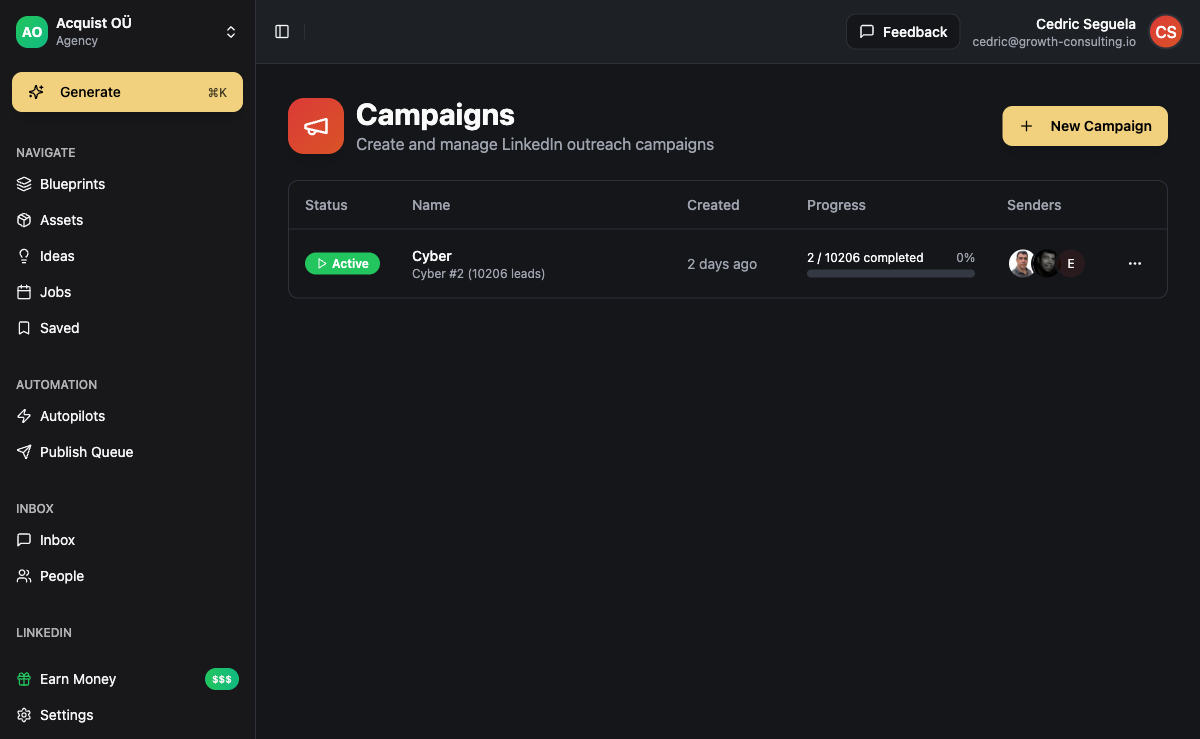
A pilot is a time-boxed engagement - typically 30 days - that lets a prospect experience your system before committing to a multi-month retainer. For hesitant buyers, pilots are the fastest path to a yes.
The AI Agency Pilot Framework has four components:
- Duration: 30 days for outreach-focused services, 60 days for content-heavy services where results take longer to accumulate
- Price: 60-75% of the full monthly retainer rate - enough to cover your costs while giving the client a real incentive to start
- Deliverable: one specific, measurable outcome agreed before launch (example: "15+ qualified replies from LinkedIn and email outreach targeting [ICP] in 30 days")
- Auto-conversion clause: if results meet the agreed threshold, the engagement automatically rolls into the full retainer unless the client opts out in writing by a specific date
The auto-conversion clause is the key detail most people miss. Without it, you close the pilot successfully and then have to re-sell the retainer separately - which takes time, creates friction, and loses momentum. With it, the retainer is the default outcome. The client has to actively opt out, which rarely happens after a successful pilot.
Do not underprice pilots out of desperation. A 30-day pilot at $800-1,200 for an outreach service is appropriate. The discount is the incentive - not a giveaway. Anything below $600 signals that you do not believe in your own results.
AI Agency Upsells That Actually Work
The best upsells are logical extensions of what you already deliver. They stack on existing infrastructure with minimal additional setup. A two-tier upsell architecture works well for most AI agencies.
Tier 1 upsells - add to any ongoing engagement:
- Additional outreach channel: client is running LinkedIn plus email. Add WhatsApp DM or Instagram direct for $500-800 per month. Minimal new setup - same leads, same sequences, new delivery channel in ACA.
- Volume increase: raise the monthly lead volume from 300 to 600 contacts for $600-900 additional per month. Same infrastructure, more throughput.
- Reporting package: weekly performance report, monthly strategy review call, and dashboard access for $300-500 per month.
Tier 2 upsells - for established clients with proven results:
- Lead magnet campaigns: comment-to-DM automation or AI chatbot qualification sequences that capture inbound interest. $1,500 setup plus $500-800 per month ongoing.
- White-label resale: configure the client to resell your service under their own brand. $1,000-2,000 per month for white-label infrastructure and support.
- CRM pipeline integration: connect the unified inbox to their existing CRM, configure deal stages, and automate lead routing. $1,000-1,500 one-time setup.
The rule of thumb: only pitch an upsell when the base service is delivering results. An unhappy client who upgrades is still an unhappy client - and now they are paying you more, which accelerates their frustration. An ecstatic client who upgrades stays for 12+ months and refers others.
What to Charge: Service Pricing Reference
The following ranges reflect what AI agencies using the BYOK model typically charge for common service configurations. These are experience-based ranges - your market, niche, and track record will influence what specific numbers the market accepts.
| Service | Setup Fee | Monthly Retainer | 30-Day Pilot |
|---|---|---|---|
| LinkedIn outreach only | $500-1,000 | $1,500-2,500 | $800-1,200 |
| Multi-channel outreach (LinkedIn + email) | $1,000-2,000 | $2,000-3,500 | $1,200-1,800 |
| AI appointment setting (full stack) | $1,500-2,500 | $2,500-4,000 | $1,500-2,000 |
| AI content generation (30 posts/month) | $500-1,000 | $1,500-2,500 | $800-1,200 |
| Full AI agency (outreach + content) | $2,000-3,500 | $3,500-6,000 | $2,000-3,000 |
These ranges assume you are the sole person involved in delivery - no subcontractors, no outsourced labor. If you are managing delivery through a team or reselling external services, factor in your actual costs before setting your floor price.
How BYOK Economics Change Your Margins
BYOK (Bring Your Own Key) is the model where agencies use their own AI API keys rather than consuming credits through a platform. This single decision is what makes AI agency pricing margins unlike any other service business.
Traditional SaaS outreach platforms charge per message, per seat, or per lead contacted. At any real scale - 300 leads per client, five active clients - those per-unit costs can consume 30-60% of your retainer revenue. A $2,500 retainer becomes a $1,000-net engagement after platform costs. That margin does not survive a few slow months or a client churning early.
With a BYOK platform like ACA, your delivery costs are predictable and near-fixed: platform subscription ($50-80 per month total) plus your actual API usage for AI personalization - typically $10-50 per month per active client at moderate volumes. For five active clients, total delivery cost runs under $300 per month.
In our experience, this margin structure is what allows AI agencies to offer pilots at discounted rates without losing money, and what makes the business survivable through the inevitable ups and downs of early client acquisition. It also means you can price competitively while remaining profitable even at low client counts - something agencies running expensive tool stacks cannot do.
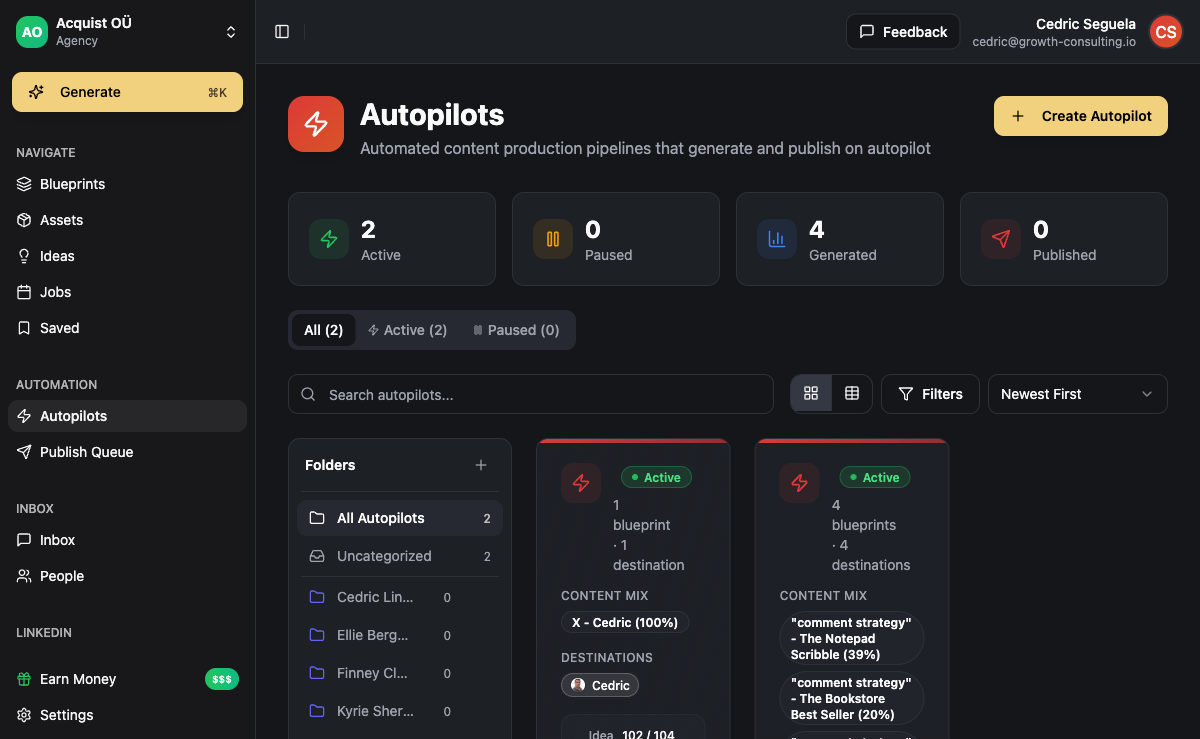
For the full picture of how to position and sell AI services once your pricing is set, see the guide to selling AI services. To understand what full-stack appointment setting delivery looks like from the inside - and how to price it - read the AI appointment setting guide. ACA's white-label and multi-client infrastructure is built for this exact pricing model - explore it at ACA for Agencies.
Frequently Asked Questions
How much should I charge for an AI agency retainer in 2026?
For outreach-focused services, the typical starting range is $1,500-3,500 per month depending on channel count and volume. Full-stack agencies combining outreach and content can charge $3,500-6,000 per month per client. The number you choose should reflect the value of the outcome - qualified meetings, warm leads, consistent content - not the hours you spend delivering it. Most new AI agencies underprice by 40-60% because they anchor on effort rather than outcome value.
Should I charge a setup fee or just a monthly retainer?
If the client is already convinced and just needs terms, charge both - a setup fee recoups your onboarding labor and increases client commitment. If the client is hesitant, skip the setup fee and offer a pilot instead. The pilot removes their biggest objection (will it actually work?) without requiring you to discount the full retainer value. Once the pilot delivers results, the retainer conversion is far easier to close.
When should I use performance-based pricing?
After you have enough campaign data to predict results reliably. Performance pricing is compelling to buyers, but it transfers risk from the client to you. If your average campaign consistently books 10-15 meetings per month across similar ICPs, you can build that into a per-meeting price with confidence. If you are still learning what your system produces in a given niche, start with a flat retainer until you have a clear baseline.
How do I respond when a client says my price is too high?
Do not immediately discount. First, understand the objection - is it budget, value uncertainty, or comparison to a cheaper alternative? If it is value uncertainty, offer the pilot. If it is genuine budget limitation, reduce the scope while keeping the per-unit rate the same - fewer channels, lower monthly volume. Never reduce the rate without reducing the scope. Discounting without scope changes sets a precedent that your prices are negotiable, which will follow you through the entire client relationship.
What contract length should I require for AI agency retainers?
Month-to-month contracts are easier to close but create higher churn risk - clients feel no commitment to stay through the optimization period when results improve. Three-month minimum commitments filter out clients who are not serious and give campaigns enough time to show meaningful results. Many agencies use the pilot as the first 30 days before the 3-month commitment begins, which gives both sides a low-risk entry point without creating a month-to-month dynamic on the full engagement.
How do I price for a reseller or agency client who wants to bring multiple sub-clients?
Price the white-label layer separately - typically $800-2,000 per month for the infrastructure, branding, and support overhead. Then charge per active client workspace at a reduced per-client rate, since setup and management overhead is lower once the base system is running. This is a reseller package, not a discount on your standard retainer pricing. Keep the two pricing structures clearly separate so neither model undercuts the other.