You are paying around $1,300 per month per client across 9 tools to run outreach, generate content, manage deals, and report results. ACA does it in one white-labeled workspace. That is the short version. The long version covers what each tool category actually offers, where best-of-breed still wins, and how to decide which model fits where your agency is today.
Quick answer: For outreach, the top options are ACA (multi-channel: LinkedIn, email, WhatsApp, Instagram, Telegram, SMS), Lemlist (email-first), and HeyReach (LinkedIn-first). For AI content generation, ACA and Taplio. For CRM, ACA's built-in module, HubSpot free tier, or Pipedrive. For client reporting, Agency Analytics or Looker Studio. ACA is the only platform that covers all four categories in one white-labeled, multi-tenant workspace - which matters once you are managing five or more clients and tool-switching overhead becomes a real cost.
Why Agency Stacks Get Expensive
The typical agency stack for running outreach and content for B2B clients looks something like this: Lemlist or Instantly for email sequences, HeyReach or Expandi for LinkedIn, Taplio or Buffer for content scheduling, a CRM for deal tracking, and Agency Analytics for client-facing dashboards. Each tool charges per seat or per client workspace.
Rough stack cost per client per month (2026 pricing): Email outreach - $30 to $59 per seat. LinkedIn tool - $79 to $99 per seat. Content scheduling - $19 to $49 per workspace. CRM (starter tier) - $25 to $50 per seat. Reporting - $12 to $25 per client. Total: $165 to $282 per client per month before AI API costs or admin overhead. At 10 clients that is $1,650 to $2,820 per month in software alone. This is why most agency operators who have been through it once end up consolidating.
There is also the white-label problem. Most of these tools are built for end-users, not agencies. You cannot put your client's branding on Lemlist or HeyReach. Every interface your client touches shows the tool's brand, not yours. That limits your ability to position the platform as part of your agency's proprietary offer - which is exactly what clients pay premium prices for.
And then there is integration debt. A Zapier workflow between your LinkedIn tool, your CRM, and your email platform breaks every two weeks. Someone on your team spends three hours fixing it. That time has a cost that never shows up on the software invoice.
Outreach Tools: LinkedIn, Email, and Multi-Channel
Outreach tooling is where agencies spend the most and accumulate the most fragmentation. The tools split cleanly into three categories: email-first, LinkedIn-first, and multi-channel.
| Tool | Channels | White-label | AI personalization | Starting price |
|---|---|---|---|---|
| ACA | LinkedIn, Email, WhatsApp, Instagram, Telegram, SMS | Yes (per-client workspace) | Full pipeline - BYOK | $50/mo |
| Lemlist | Email + basic LinkedIn steps | No | Template variables | $59/seat/mo |
| Instantly | No | Basic AI prompts | $37/mo | |
| HeyReach | Partial (agency plan) | No | $79/sender/mo | |
| Expandi | No | No | $99/seat/mo | |
| Clay | Enrichment only - not a sender | No | No (outputs to other tools) | $149/mo |
Lemlist is email-first. ACA adds LinkedIn, WhatsApp, and AI content generation in the same sequence builder. If email is your only channel and your client lists are small, Lemlist works well. The moment you add LinkedIn to the mix, you need a second tool - and you're managing two disconnected outreach systems with no shared prospect state.
Instantly focuses on email volume with strong deliverability infrastructure. It is a solid email-only platform. ACA covers email at scale plus LinkedIn plus AI personalization plus agency white-label. At similar price points, the math shifts quickly once multi-channel matters.
HeyReach is LinkedIn-first, built for multi-account LinkedIn outreach with dedicated IP management. It does not coordinate with email. You are running two outreach systems for every client - one for LinkedIn, one for email - with no native handoff when a prospect replies on one channel and needs to be removed from the other.
Expandi runs via cloud-based LinkedIn automation - higher account safety than browser extensions - but it is LinkedIn only and does not include content generation or email. At $99 per seat per month for LinkedIn alone, the cost stacks up fast for agencies managing multiple client accounts.
Clay is a lead enrichment and workflow tool, not a sender. Clay finds and enriches leads with waterfall lookups across multiple data providers. You still need a separate tool to run sequences. ACA includes ICP scoring and lead enrichment inside the same platform where campaigns run, which removes the Clay-to-sender export step entirely.
For a full side-by-side on multi-channel outreach platforms, see the complete multi-channel outreach tool comparison. For LinkedIn specifically, the LinkedIn outreach automation guide covers safe volume limits and sequence structures.
AI Content Tools for Client Delivery
Agencies that include content production in their offer - LinkedIn posts, email copy, social media, video scripts - need AI tooling that goes beyond generic prompts. The differentiation that matters is whether the tool learns your client's brand voice or just generates generic output you have to rewrite.
| Tool | Content types | Brand voice training | Scheduling | White-label |
|---|---|---|---|---|
| ACA | Text, image, video, TTS | Yes - brand voices, characters, ICPs, knowledge base | Yes | Yes |
| Taplio | LinkedIn posts | Style profile (limited) | Yes | No |
| Buffer / Hootsuite | Scheduling only | No | Yes | No |
| Jasper / Copy.ai | Text (generic) | Limited brand voice profiles | No | No |
Taplio writes LinkedIn posts and handles scheduling. ACA does that plus outreach, email sequencing, CRM, and white-label - in one platform. If LinkedIn personal branding is your only service, Taplio is a reasonable choice. If content and outreach both live in your offer, you are maintaining two separate platforms for what should be one workflow.
Buffer and Hootsuite are schedulers. They are calendars, not content engines. You bring the posts - they publish them. ACA generates the posts and schedules them. The difference shows up in delivery time: scheduling is a 10-minute task, content creation is a 3-hour task. That is where the leverage is.
Generic AI writers like Jasper or Copy.ai generate text from prompts. They produce output in the voice of "generic competent writer," not in the voice of your client's specific brand. ACA's blueprint system trains on each client's brand voice, ICP targeting, products, and knowledge base. The outputs require far less editing because the context is built in, not prompted in fresh each time.
For the broader picture of AI tools built specifically for agency delivery, the AI agency tools roundup covers the category in more depth.
CRM: Tracking Deals and Client Activity
Most agencies need CRM for two distinct use cases. First, managing their own new business pipeline - tracking prospect conversations, deal stages, and follow-ups for landing new clients. Second, optionally providing CRM as part of the client deliverable when lead tracking is included in the service scope.
CRM options for agencies in 2026: HubSpot's free CRM handles contact management, deal tracking, and basic email logging - sufficient for agencies with fewer than 20 active deals at a time. Pipedrive ($14-$49 per seat per month) adds stronger pipeline visualization and automation rules. ACA includes a native CRM within each client workspace - contacts, companies, and deal stages live in the same platform as outreach campaigns, which means reply data flows directly into deal records without a Zapier sync. For agencies that want to include CRM access in their client offering, ACA's multi-tenant architecture keeps each client's data isolated and white-labeled.
The integration cost of a standalone CRM is consistently underestimated. When your outreach tool and your CRM are separate systems, someone spends time syncing prospect status, debugging broken webhooks, and manually moving contacts between stages when they reply or go cold. Platforms where outreach and CRM share the same data model eliminate this friction category entirely.
Reporting and Analytics Dashboards
Client-facing reporting is a retention lever. Clients who see clear metrics tied to outcomes renew. Clients who do not see clear value cancel at the first sign of a slow month.
- Agency Analytics: Purpose-built for agencies. White-labeled dashboards, multi-client management, and connectors for SEO, social, and ads data. Starts around $12 per client per month. Best fit for full-service agencies delivering SEO, content, and ads alongside outreach who need one reporting layer across all channels.
- Looker Studio (Google): Free, highly customizable, connects to most data sources via connectors. Requires setup time per client and some technical skill to configure well. Not white-labeled out of the box without custom domain configuration.
- DashThis: Simpler than Looker Studio, white-labeled, pre-built templates for common agency metrics. Around $39 per month for up to three dashboards. Good middle ground for agencies that want white-label reporting without the setup investment of Looker Studio.
- Native ACA reporting: Campaign metrics - send rates, connection acceptance rates, reply rates, meetings booked - and content performance are native to each client workspace. For agencies whose core deliverable is outreach and content generation, built-in reporting may cover 80% of what clients need without a standalone reporting tool subscription.
If you are delivering SEO, paid media, or social alongside outreach, a dedicated reporting tool is worth the investment because you need a single client-facing view across channels that ACA does not cover. If outreach and content are your full scope, native platform reporting reduces the stack by one more tool and one more monthly invoice.
The All-in-One Case: ACA
ACA is built around a premise grounded in experience running an outbound agency: agencies should not be paying for 9 tools to deliver a single client service. The platform consolidates multi-channel outreach (LinkedIn, email, WhatsApp, Instagram, Telegram, SMS), AI content generation (text, image, video, TTS), CRM, and unified inbox management into one multi-tenant platform with per-client workspace isolation and built-in white-label support.
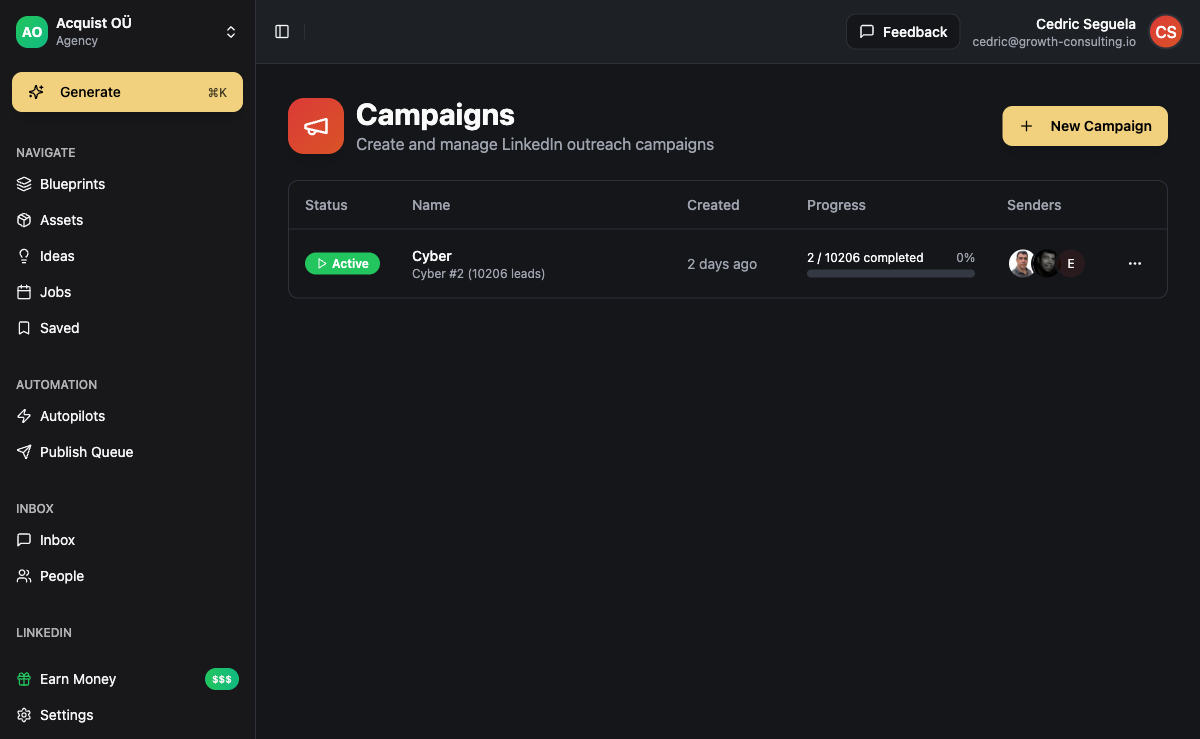
The BYOK model means your AI content generation costs are direct - you pay model providers (OpenAI, Anthropic, Google) at published rates with no markup from ACA. In practice this means AI generation infrastructure for a typical client content pipeline runs well under $20 per month at current model pricing, compared to flat-fee AI tool subscriptions that charge $79 to $99 per month regardless of usage volume.
Multi-channel coordination is native, not an integration. LinkedIn, email, and WhatsApp sequences share prospect state - when a prospect replies on one channel, all other pending touches for that prospect stop automatically. No Zapier rules required. No manual cleanup of duplicate follow-ups.
White-label is part of the core product, not a paid add-on tier. Each client workspace shows your agency name, not ACA's. Clients access what looks like your proprietary platform - which is the right positioning for reselling platform access as part of a premium agency offer.
For a comparison of white-label outreach platforms specifically, see the white-label outreach platform guide. If you are building the agency itself, the how to start an AI agency guide covers niche selection, offer structure, and delivery model alongside the tooling decisions.
Consolidated vs Best-of-Breed: How to Choose
Go best-of-breed when: you have a single-channel service (email-only or LinkedIn-only), you have a technical team that can manage integrations and debug broken syncs, you are at fewer than five clients and operational overhead is not yet a meaningful cost, or you have specific tool requirements that no consolidated platform matches.
Go consolidated (ACA) when: you deliver multi-channel outreach (LinkedIn plus email plus WhatsApp), you want to include platform access in your client offer with your agency's branding, you are managing five or more clients and tool-switching overhead adds up to real hours weekly, you need AI content generation and outreach to run in the same pipeline rather than across separate systems, or you want per-client workspace isolation without building it yourself.
The break-even math is simple. If you are paying $165 to $282 per month per client across four to five tools, and a consolidated platform runs $50 to $100 per month for the whole agency, the savings cover the platform cost at one client and compound with every client you add. The operational benefit - fewer vendor logins, no integration maintenance, one support queue instead of five - is harder to put a number on but is usually larger than the direct cost savings.
The agency business model and unit economics are covered in depth in the AI agency business model and pricing guide - which explains how platform consolidation affects margin at different client counts.
Frequently Asked Questions
What is the most important tool category for an agency starting out?
Outreach infrastructure first. Everything else in an agency depends on pipeline - and pipeline depends on a reliable, repeatable way to get conversations started with qualified prospects. Content tools and reporting tools amplify value delivery, but they do not generate leads on their own. Get your LinkedIn plus email outreach running on a platform you trust, then layer in content and reporting as your client base grows and delivery quality becomes the constraint.
Can I run an agency on ACA alone without additional tools?
For outreach, AI content generation, CRM, and inbox management - yes, completely. You may still want a dedicated reporting tool like Agency Analytics if your clients expect polished multi-channel dashboards beyond outreach and content metrics, and a project management tool (Notion, Linear, or Asana) for internal task tracking. But the core delivery stack - the tools that directly touch your clients' campaigns - runs entirely in ACA without integration overhead.
How does white-label work in agency outreach tools?
True white-label means your clients see your agency's brand at every touchpoint they interact with - not the tool's brand. In ACA, each client workspace carries your agency name and logo. Clients log in to what looks like your proprietary platform. This matters for two reasons. First, it protects your positioning: clients are buying your agency's system, not renting access to a third-party tool they could go sign up for directly. Second, it raises perceived value: a branded platform looks like an asset you built, not a resold subscription. Most outreach tools are not built with this in mind. ACA's multi-tenant architecture makes it a default capability, not an add-on fee.
Is Clay worth adding to an agency stack?
Clay is a strong data enrichment and workflow tool - particularly useful when you need sophisticated lead sourcing with conditional waterfall enrichment across multiple data providers (Apollo, Hunter, Snov.io, and others in sequence). The trade-off is that Clay is not a sender. You enrich in Clay, then export to a separate outreach platform to run the actual sequences. If you have complex ICP-matching requirements or need enrichment pipelines that go beyond basic LinkedIn plus email lookup, Clay adds value. If you want one system that handles enrichment and campaign execution, ACA's built-in ICP scoring and lead enrichment covers the use case without the export step.
Do agencies need separate email warm-up tools?
Yes - unless your sending platform includes warm-up natively. New inboxes and sending domains require a warm-up period of three to six weeks before you can run cold email at meaningful volume without damaging deliverability. ACA integrates with ZapMail and Mailreach for warm-up, which keeps this inside the platform rather than requiring a separate warm-up tool subscription and manual inbox configuration. For agencies managing multiple client sending accounts, built-in warm-up integration removes one more vendor and one more monthly line item from the stack.