
An AI SDR (AI Sales Development Representative) is a software agent that handles the prospecting, outreach, qualification, and follow-up tasks traditionally done by a human SDR - at a fraction of the cost, running 24/7, across multiple channels simultaneously. In 2026, agencies and sales teams are replacing or augmenting their SDR functions with AI agents powered by platforms like ACA.
What Is an AI SDR?
An AI SDR is an automated sales agent that performs the top-of-funnel prospecting and outreach tasks a human Sales Development Representative would handle. This includes finding prospects, sending personalized connection requests and cold emails, following up across channels, qualifying responses, and routing warm leads to human closers.
The core difference: a human SDR costs $40,000-$70,000 per year in salary, plus benefits, tools, management time, and ramp time. An AI SDR running on a BYOK platform like ACA costs $50-80 per month in platform fees plus your API costs - and it never calls in sick, goes on vacation, or quits after you have trained it.
This is not about replacing human relationships at the deal-closing stage. The AI handles everything before the first real conversation happens. Once a prospect shows intent - replies, books a call, asks a question - a human takes over.
What an AI SDR Actually Does Day-to-Day
Here is exactly what a well-configured AI SDR handles automatically:
Prospecting and Lead Research
The AI pulls leads from your defined ICP (Ideal Customer Profile) - job title, company size, industry, location, LinkedIn activity - using integrations like Apify's B2B Lead Finder or direct LinkedIn search exports. It enriches each lead with additional data points: recent posts, job changes, company funding events, technology stack.
This enrichment is what enables personalization at scale. Instead of "Hi [First Name], I noticed you work at [Company]," your AI SDR sends messages that reference the prospect's actual LinkedIn post from last week or their recent company announcement.
Personalized Multi-Channel Outreach
The AI SDR executes your defined outreach sequence across 6 channels: LinkedIn connection request, LinkedIn message, email, WhatsApp, Instagram DM, and Telegram. It personalizes each message using the prospect's enriched data and your brand voice settings.
In our experience, multi-channel sequences with AI personalization get 2-3x higher response rates than single-channel generic templates. The AI does not just send one message and hope - it follows a structured sequence with timing, conditions, and channel switching based on whether the prospect has responded or engaged.
Lead Qualification and Handoff
When a prospect responds, the AI SDR can handle initial qualification conversations using your knowledge base: answering common questions, identifying fit based on predefined criteria, and either routing the lead to book a call or filtering it out as a poor fit. Qualified leads land directly in your unified inbox, flagged and ready for human follow-up.
AI SDR vs Human SDR: A Direct Comparison
This comparison focuses on the top-of-funnel SDR function specifically - not the full sales cycle. Compare apples to apples:
| Factor | Human SDR | AI SDR (ACA) |
|---|---|---|
| Monthly Cost | $4,000-$7,000 (salary + benefits + tools) | $50-$150/mo (platform + API costs) |
| Outreach Channels | 1-2 (usually email + LinkedIn) | Up to 6 (LinkedIn, Email, WhatsApp, Instagram, Telegram, SMS) |
| Daily Volume | 50-100 outreach touches | 200-500 outreach touches (within platform limits) |
| Operating Hours | 8-9 hours/day, weekdays only | 24/7, all days |
| Personalization | Manual research for high-value prospects only | AI-generated personalization for every prospect |
| Ramp Time | 60-90 days to full productivity | 1-3 days to configure and launch |
| Scalability | Linear - hire more people | Non-linear - add campaigns, minimal cost increase |
| Complex Objection Handling | Strong - nuanced, adaptive | Limited - handles common objections via knowledge base |
| Relationship Building | Natural, human connection | Limited to initial touchpoints before handoff |
| Best For | Enterprise deals, complex ICP, high-touch sales | SMB and mid-market, defined ICP, consistent outreach volume |
How to Build Your AI SDR in 5 Steps
The AI SDR Framework is a structured approach to deploying an automated sales agent that handles top-of-funnel work without human involvement. Here is exactly how to set it up:
Step 1: Define Your ICP Precisely
Your AI SDR is only as good as the list it works from. Define your Ideal Customer Profile with specific filters: job titles (2-3 max), company size range, industry, geography, and any behavioral signals (recently funded, hiring for sales roles, posting about a problem you solve). The tighter the ICP, the better the personalization and the higher the response rate.
Step 2: Import and Enrich Your Lead List
Use Apify's B2B Lead Finder or LinkedIn search exports to pull a targeted list. Import into ACA's leads module. Run ICP scoring to prioritize Tier 1 prospects. The enrichment step - pulling recent LinkedIn posts, job change data, company news - feeds the AI personalization engine in the next step. See the full guide on B2B lead generation with AI for building the right list.
Step 3: Build Your Campaign Sequence
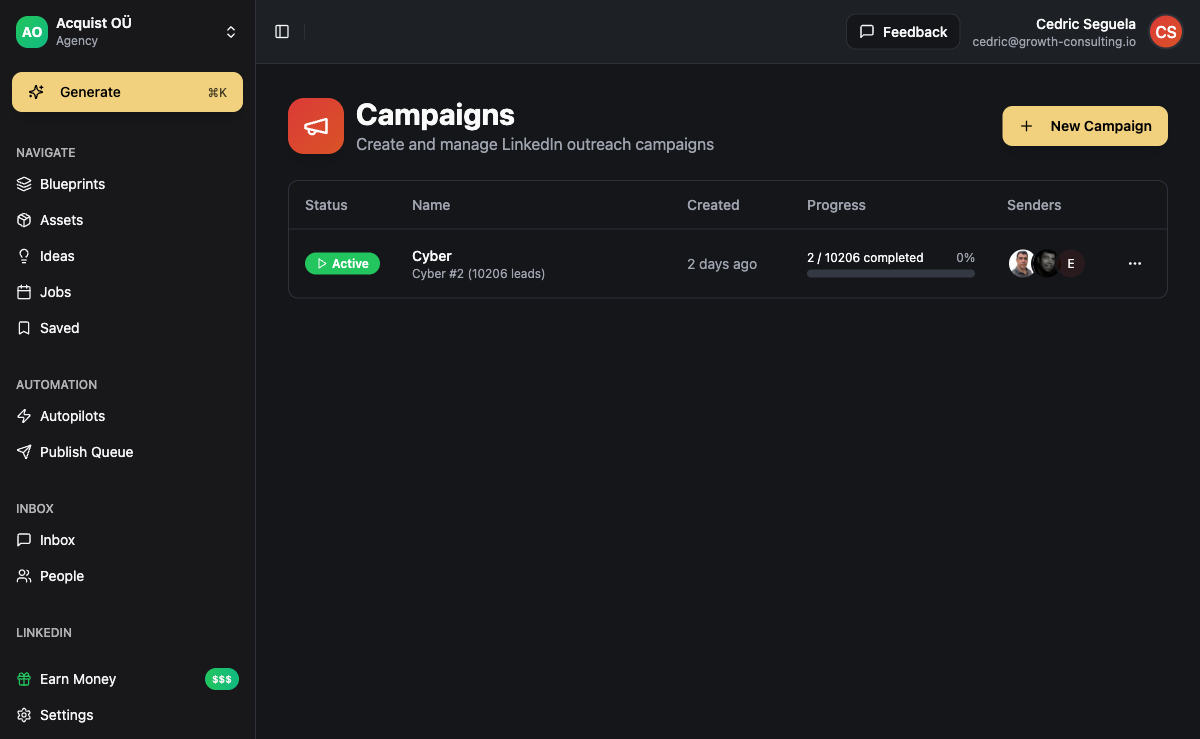
In ACA's visual campaign builder, design your multi-channel sequence. A standard AI SDR sequence looks like this: LinkedIn connection request (personalized note) on Day 1 - wait 2 days - LinkedIn message if connected on Day 3 - email if not connected by Day 5 - LinkedIn follow-up message on Day 8 - final email on Day 12. Set conditions at each step: if the prospect replies, stop the sequence and flag in inbox. If they connect but do not reply, continue to the next step.
Step 4: Write AI-Personalized Message Templates
Your message templates use dynamic variables fed by the enrichment data. The opener might reference a prospect's recent LinkedIn post, a company milestone, or a shared connection. The value proposition connects their specific context to your offer. The CTA is a low-friction ask - a question, not a pitch. ACA's blueprints handle this: you write the template structure, the AI fills in the personalization for each prospect.
Step 5: Set Up Your Inbox and Handoff Process
All replies flow into ACA's unified inbox, tagged by campaign and channel. Define your handoff criteria: what makes a lead "qualified"? Set up n8n automations to notify the right human when a qualified reply comes in. The AI continues to handle nurturing for unqualified leads while humans focus on closing conversations with interested prospects.
What AI SDRs Cannot Replace
Being honest here matters. AI SDRs are not a complete replacement for human sales in every context. Here is where they have real limits:
Enterprise and complex deals: When your deal size is $50K+, buyers expect personalized human engagement from the first conversation. An AI SDR can still handle initial contact, but the expectation for high-touch relationship building kicks in quickly. Use AI to identify the right people, then have humans take over immediately after the first signal.
Nuanced objection handling: When a prospect replies with a complex, multi-layered objection or a very specific question about your product, current AI agents handle common objections from a knowledge base but struggle with novel, context-specific responses. This is the handoff trigger - a human needs to step in.
Relationship-driven industries: Some industries (financial services, legal, certain enterprise verticals) buy on relationships and trust built over time. AI SDRs can keep you on the radar, but the relationship-building work still needs a human touch.
The honest model: AI SDR handles volume (prospecting, outreach, initial qualification) - humans handle connection (closing, relationship management, complex conversations). This hybrid approach is what actually works in 2026.
Using ACA as Your AI SDR Engine
ACA is built for exactly this workflow. The platform combines the tools you need for a complete AI SDR operation:
- Lead import and ICP scoring - import from Apify, CSV, or LinkedIn, score automatically against your ICP
- Visual campaign builder - drag-and-drop multi-channel sequences with conditional logic
- AI personalization - generates personalized message openings using prospect data and your brand voice
- 6-channel outreach - LinkedIn, email, WhatsApp, Instagram, Telegram, SMS in one sequence
- Unified inbox - all replies across all channels in one place, with handoff flags
- BYOK economics - bring your own OpenAI or Anthropic API key, keeping costs at $50-80/month vs $1,000+/month SaaS stacks
For agencies running AI SDR services for clients, ACA's white-label capabilities let you manage multiple client workspaces under your own brand. Each client gets their own isolated workspace - their leads, their sequences, their inbox. You manage everything from one dashboard.
Learn more about running multi-channel outreach at scale and how LinkedIn outreach automation fits into your AI SDR stack.
Frequently Asked Questions
What does AI SDR stand for?
AI SDR stands for AI Sales Development Representative. It is a software agent that automates the prospecting, outreach, and lead qualification tasks traditionally done by a human SDR. The AI handles top-of-funnel activities - finding leads, sending personalized messages across multiple channels, qualifying responses - while human sales reps focus on closing deals with interested prospects.
How much does an AI SDR cost compared to a human SDR?
A human SDR costs $4,000-$7,000 per month when you factor in salary, benefits, tools, and management overhead. An AI SDR running on a BYOK platform like ACA costs $50-150 per month in platform and API fees. The output is different - AI SDRs excel at volume and consistency, humans excel at nuanced relationship-building - but for top-of-funnel prospecting and outreach, the cost difference is dramatic.
Can an AI SDR replace a human SDR completely?
For many SMB and mid-market sales motions, an AI SDR can handle the full top-of-funnel function that a junior human SDR would handle. For enterprise deals, high-complexity products, or relationship-driven industries, AI SDRs work best as a complement to human SDRs - handling volume prospecting and initial outreach while humans focus on warm leads and active conversations. The hybrid model (AI for volume, human for closing) consistently outperforms either approach alone.
How many leads can an AI SDR contact per day?
Volume depends on the platform and channel limits. On LinkedIn, safe automation limits are 20-30 connection requests per day per account and 100-150 messages per day. On email, daily sending limits depend on your domain warm-up status - typically 50-200 per day for a warmed domain. Combined across channels (LinkedIn + email + WhatsApp), an AI SDR on ACA can make 200-500 outreach touches per day within safe limits. Dial in volume gradually to maintain deliverability and account health.
What channels can an AI SDR use?
A fully-configured AI SDR can operate across LinkedIn (connection requests, direct messages, InMail), email, WhatsApp, Instagram DM, Telegram, and SMS. Most single-channel tools only cover one or two of these. ACA's multi-channel campaign builder supports all 6 in a single coordinated sequence, switching channels based on whether the prospect has responded or engaged on each channel.
How long does it take to set up an AI SDR?
With ACA, setup takes 1-3 days: one day to import and score your lead list, one day to build and test your campaign sequence, and one day for final review and launch. Compare that to a human SDR's 60-90 day ramp time. The configuration work mostly happens in the first few hours - defining your ICP, writing message templates, connecting your LinkedIn and email accounts via Unipile.