
B2B lead generation with AI is no longer a competitive advantage - it is table stakes. Companies using AI to find, score, and engage prospects are booking significantly more meetings than those running manual outreach. This guide covers 7 concrete strategies for filling your pipeline with AI, starting today.
What Is B2B Lead Generation with AI?
B2B lead generation with AI is the practice of using machine learning and automation to identify, qualify, and engage potential business customers at a scale that manual processes cannot match. AI handles the research, personalization, scoring, and follow-up - so your team focuses only on conversations that are ready to convert.
In practice, this means AI tools scraping and enriching prospect data, scoring leads against your ICP, writing personalized outreach messages, and triggering follow-ups based on engagement signals - all without manual intervention per lead.
Why AI Changes the Lead Generation Equation
Traditional B2B lead gen has three bottlenecks: finding the right people, personalizing outreach at volume, and following up consistently. AI removes all three.
| Task | Manual Approach | AI-Powered Approach |
|---|---|---|
| Lead sourcing | SDR manually searches LinkedIn, 20-30 leads/day | Automated scraping + enrichment, 500+ leads/day |
| ICP scoring | Human judgment, inconsistent | Automated scoring against 20+ ICP criteria |
| Message personalization | 15-20 min per message for real personalization | AI-generated from prospect data in seconds |
| Follow-up | Depends on SDR memory and discipline | Automated sequences across 6 channels |
| Response handling | Business hours only | 24/7 AI qualification and booking |
In our experience, agencies that switch from manual to AI-powered B2B lead generation see their outreach volume increase 10x with the same headcount. The leverage is real and measurable.
Strategy 1: Define Your ICP and Let AI Score Every Lead
The most common reason lead generation campaigns fail is poor targeting. If you send 10,000 messages to the wrong people, you get zero meetings. AI scoring changes this dynamic.
Define your Ideal Customer Profile: company size, industry, job title, funding stage, tech stack, geography. Import a raw lead list and let the AI score each lead against those criteria before a single message goes out.
ACA's ICP scoring engine assigns each lead a match score based on your defined criteria. High-score leads get prioritized in sequences. Low-score leads get filtered or routed to a different nurture track. You stop wasting outreach budget on leads who will never convert.
See how the lead management system works: ACA Lead Management.
Strategy 2: LinkedIn Outreach at Scale with AI Personalization
LinkedIn remains the highest-converting channel for B2B lead generation - when done right. The problem is that manual LinkedIn outreach caps out at 20-30 personalized messages per day before it becomes unsustainable.
AI personalization breaks that ceiling. Instead of writing each message from scratch, AI generates personalized openers using the prospect's recent posts, company news, job title, and LinkedIn activity. You review the template, approve the logic, and the system handles execution.
In our platform data, connection requests with AI-personalized messages that reference a prospect's specific content or recent activity see meaningfully higher acceptance rates than generic "I'd love to connect" messages. The difference is not marginal - personalization at this level matters.
Read the full LinkedIn strategy: AI Lead Generation: The Complete Guide.
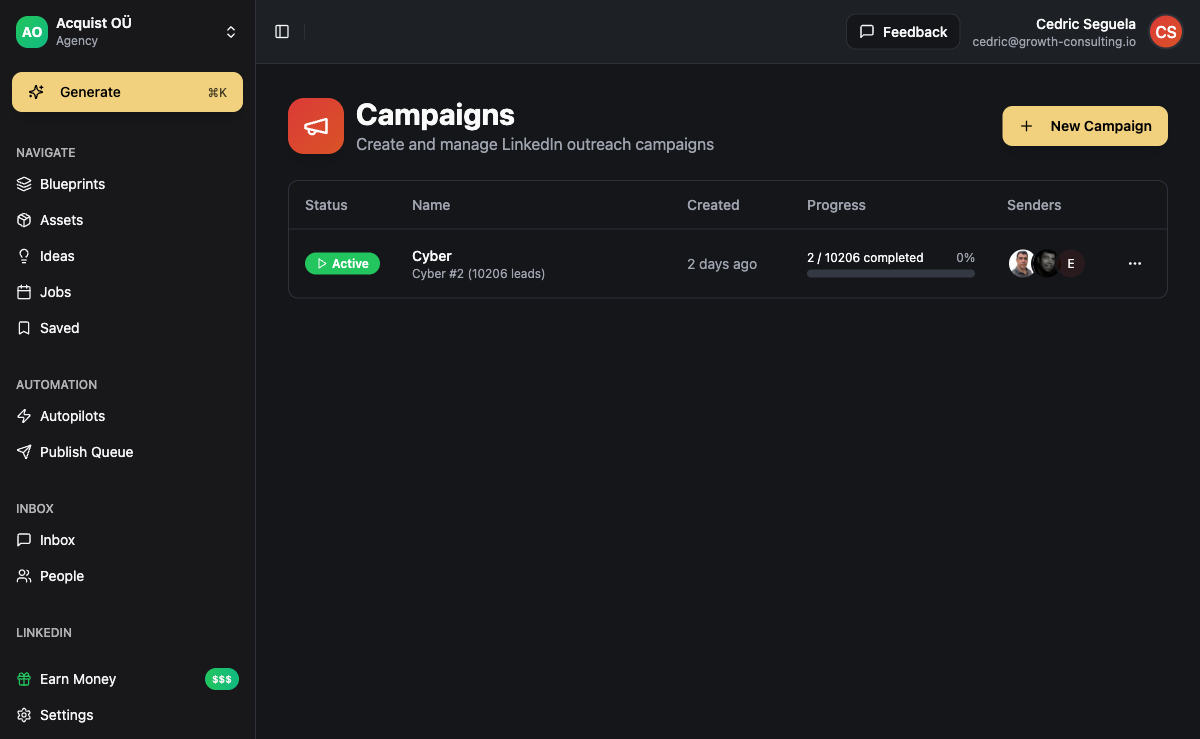
Strategy 3: Cold Email with AI-Personalized Sequences
Cold email is not dead - bad cold email is dead. Generic "Hi [FirstName], I help companies like yours..." emails get ignored or reported as spam. AI-personalized email changes the dynamic entirely.
The formula that converts in 2026:
- Line 1: AI-personalized opener using a specific, verifiable detail about the prospect or their company
- Lines 2-3: One clear outcome you deliver - not a feature, an outcome
- Line 4: Low-commitment CTA ("Worth a 15-min call this week?")
- Follow-ups: 3-4 automated follow-ups with different angles, spaced 2-4 days apart
Keep it short. Three to four lines. One ask. AI generates hundreds of personalized variants daily without your involvement. Volume plus personalization is the formula.
Strategy 4: Multi-Channel Sequences Across LinkedIn, Email, and WhatsApp
Multi-channel outreach is the practice of contacting prospects across 3 or more communication channels in a coordinated sequence, with each channel's message tailored to the prospect's engagement history on previous channels.
A typical B2B sequence that converts:
- Day 1: LinkedIn connection request with personalized note
- Day 3: LinkedIn message (if accepted) or cold email (if no response)
- Day 5: Follow-up email or LinkedIn InMail
- Day 8: WhatsApp message for high-ICP prospects who opened but did not reply
- Day 12: Final LinkedIn message or email with breakup framing
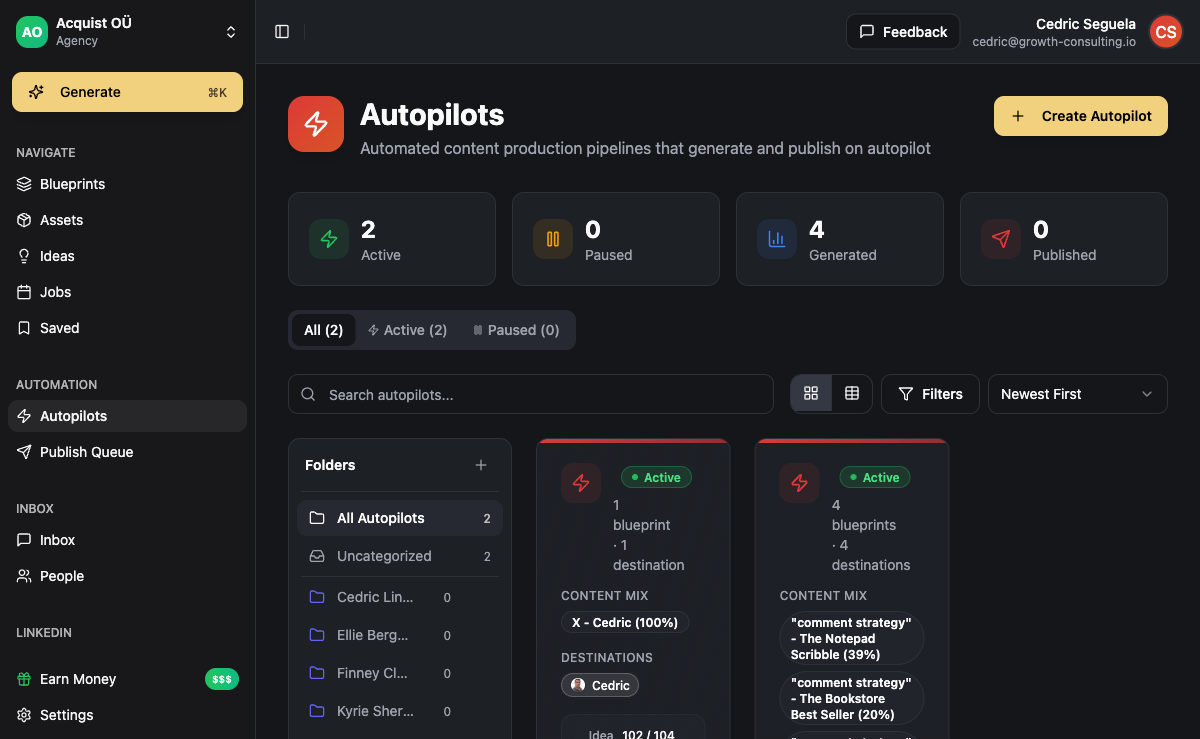
Running this manually across 500 leads is impossible. With ACA's visual campaign builder, you map this sequence once and the platform handles execution, channel switching, and condition-based routing automatically.
Build your first multi-channel sequence: ACA Campaign Builder.
Strategy 5: Lead Magnet Campaigns with AI Qualification
Lead magnets - checklists, guides, templates, calculators - attract warm leads who raise their hand. But most businesses lose these leads because there is no immediate follow-up system in place.
AI changes the economics of lead magnets by automating qualification and booking. Someone downloads your "B2B Lead Generation Checklist" via a LinkedIn post. ACA captures the lead, sends an instant DM with the content, asks 2-3 qualifying questions, and routes qualified responders into a booking sequence - all without human intervention.
The conversion from lead magnet download to booked call is dramatically higher when follow-up happens within minutes rather than hours or days. AI enables that response speed at scale across thousands of leads simultaneously.
Strategy 6: AI SDR for 24/7 Lead Response and Follow-Up
An AI SDR is a system that monitors inbound signals - email replies, LinkedIn message responses, form submissions - and responds in real time, any hour of the day or night.
The 24/7 response capability alone is a significant competitive advantage in B2B lead generation. A prospect replies to your LinkedIn message at 11 PM. Your AI responds at 11:01 PM. The competitor who assigned this to a human SDR responds the next morning - after the prospect has moved on.
AI SDRs in ACA can handle objections, answer product questions using your knowledge base, and hand off to a human only when the prospect is qualified and ready to book. No babysitting required.
Explore the full capability: ACA for Sales Teams.
Strategy 7: Content-Led Lead Generation on Autopilot
Content is a long-game B2B lead generation channel - but AI compresses the timeline. Instead of one person publishing twice a week, AI generates 20-30 pieces of on-brand content per month across LinkedIn, newsletters, and blogs, publishing on schedule without your involvement.
The mechanism: set up your brand voice, ICP, product knowledge, and content pillars once. The AI generates posts, carousels, and newsletters that attract inbound leads - people who engage with your content, follow your page, and eventually reach out to you.
Combine this with outbound sequences and you have both inbound and outbound running simultaneously. This is the 6-Channel Lead Generation Model - using ACA's multi-channel outreach (LinkedIn, email, WhatsApp, Instagram, Telegram, SMS) alongside automated content publishing to create a compound lead generation flywheel where outbound warms prospects and inbound content closes them.
Putting It All Together: The Full-Funnel AI Lead Generation Stack
The 7 strategies above are not independent tactics - they work best as a system. Here is how agencies using ACA run the full B2B lead generation funnel:
| Funnel Stage | Strategy | ACA Feature |
|---|---|---|
| Targeting | ICP scoring on imported leads | Lead management + ICP scoring |
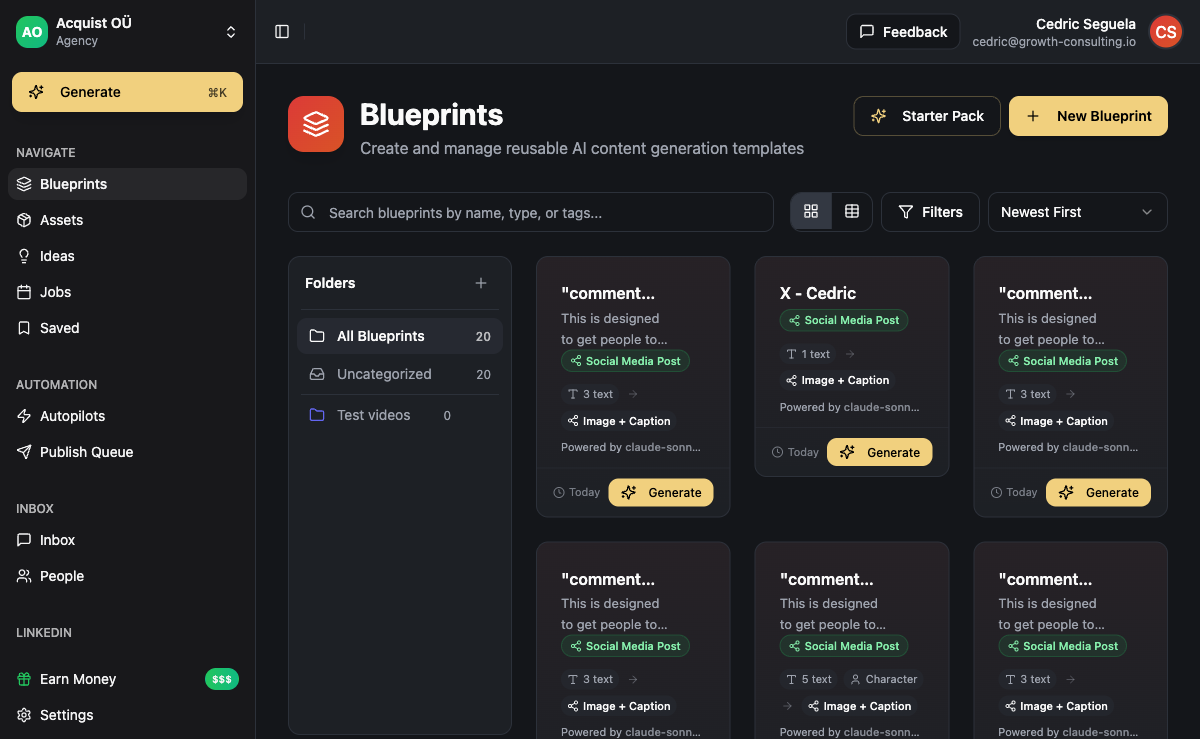
| Awareness | Content-led lead gen on autopilot | Blueprints + Autopilots |
| Outreach | Multi-channel sequences (6 channels) | Campaign builder |
| Inbound capture | Lead magnet campaigns with AI qualification | Lead magnets + AI chatbot |
| Follow-up | AI SDR - 24/7 response and qualification | Unified inbox + AI agent |
| Conversion | Automated booking sequences | Campaign sequences |
The BYOK Economics Model makes this accessible: because ACA uses your own AI API keys, the delivery cost for this entire stack - outreach, content, qualification, follow-up - runs $50-80/month per client in actual AI usage costs. Not $50-80/month for one tool. That is your total AI cost across all six strategies.
For a deeper look at software options, read: Best AI Lead Generation Software in 2026.
Frequently Asked Questions
How much does AI lead generation cost for a B2B company?
Costs vary significantly depending on the platform model. Traditional SaaS platforms charge per seat or per lead - LinkedIn automation tools run $79-99 per seat per month, cold email platforms run $47-100/month, and lead enrichment adds another $50-200/month. With a BYOK platform like ACA, you pay one subscription plus your actual AI API usage, which typically runs $50-80/month per client for a full multi-channel stack. In our experience, agencies switching to BYOK models see their per-client delivery costs drop significantly compared to per-seat SaaS pricing.
What is the best channel for B2B lead generation with AI in 2026?
There is no single best channel - the answer depends on your ICP. LinkedIn works best for targeting decision-makers at mid-to-large companies. Cold email works best for high-volume prospecting across a broad ICP. WhatsApp outperforms both for warm follow-up in markets where it is commonly used for business communication. The highest-performing B2B lead generation strategies in 2026 use all three in a coordinated sequence rather than picking one channel and ignoring the others.
How do I personalize outreach at scale without it feeling fake?
AI personalization works best when it references specific, verifiable details - a recent LinkedIn post the prospect published, a company announcement, a shared connection, or a relevant industry event. Generic personalization ("I see you work in SaaS!") performs no better than templates. Real personalization ("I read your post about the challenges of sales team ramp time - that is exactly the problem we solve") converts meaningfully better. AI generates these openers from prospect data automatically, so you get real personalization at volume without manual research per lead.
How long does it take to see results from AI lead generation?
LinkedIn connection request campaigns typically show results within 48-72 hours of launch - accepted connections and first replies. Cold email campaigns take slightly longer, usually 5-7 days before meaningful reply data accumulates. Full multi-channel sequences - running LinkedIn, email, and WhatsApp - often show compounding results after 2-3 weeks as more touchpoints land. In our experience, agencies see their first booked meetings within the first week of launching a well-configured campaign.
Can AI lead generation replace my SDR team?
AI is most effective at replacing the top-of-funnel work SDRs spend most of their time on: list building, research, outreach, and follow-up. It is less effective at complex negotiation and relationship-building once a prospect is engaged. Most agencies using ACA run with no dedicated SDR - the AI handles all top-of-funnel activity and routes qualified, interested prospects directly to a closer. Whether that means you or a small closing team depends on your volume and close rate.
What data do I need to start B2B lead generation with AI?
At minimum: a target company list or defined ICP criteria (industry, company size, job title, geography). From there, you can use Apollo, LinkedIn Sales Navigator, or ACA's Apify integration to build your lead list with enriched contact data. The richer the data going in - recent posts, company news, tech stack, recent hires - the better the AI personalization going out. You do not need a perfect list to start. Start with what you have and refine based on response data from your first campaign.