Cold email open rates in 2026 land between 30% and 55% for well-optimized campaigns - but that number is almost meaningless without context. Apple Mail Privacy Protection, Outlook proxy fetching, and Gmail image caching have made tracked open rates unreliable as a performance signal. Here is what real open rates look like, why they vary, and what you should actually optimize for instead.
Short answer: A healthy cold email open rate for B2B outreach in 2026 is 35-50%. Below 25% almost always signals a deliverability problem - your emails are landing in spam or the promotions tab. Above 60% consistently usually means your tracking pixel is misfiring from Mail Privacy Protection inflation. Reply rate is a more reliable signal than open rate for evaluating campaign health.
What Is Cold Email Open Rate?
Cold email open rate is the percentage of delivered cold emails that were recorded as "opened" by your sending platform. It is measured by a 1x1 invisible tracking pixel embedded in the email - when the pixel loads, the platform counts an open. Because modern email clients pre-load images without the recipient actually reading the email, reported open rates have become an imprecise indicator rather than a reliable count of humans who read your message.
Open rate is calculated as: (opens / delivered) x 100. Most platforms define "delivered" as sent minus hard bounces - meaning emails that land in the spam folder still count as "delivered" even though the recipient never sees them.
The practical problem: when Apple launched Mail Privacy Protection (MPP) in 2021, it began pre-fetching email content - including tracking pixels - for Mail app users on iOS and macOS. This means Apple Mail fires the tracking pixel before the user decides to read the email. You see an "open"; the recipient may have never touched it. Outlook has similar proxy behavior in some Microsoft 365 configurations. Gmail occasionally caches images in ways that trigger repeated opens from a single email. The result: reported open rates for many B2B lists run 10-20 percentage points above actual human reads.
2026 Cold Email Open Rate Benchmarks
Cold email open rate ranges by campaign quality (2026):
- Underperforming - under 20%: Almost always a deliverability issue. Emails are landing in spam or being blocked before delivery. Fix authentication records and domain warm-up before touching copy or subject lines.
- Average - 20-35%: Typical for campaigns with adequate deliverability but generic subject lines or broad targeting. Room to improve both inbox placement and message relevance.
- Healthy - 35-50%: What well-maintained cold email infrastructure with personalized subject lines consistently produces. This range reflects real engaged opens plus some MPP inflation.
- Inflated - 55%+ consistently: Usually MPP-driven rather than genuine opens, especially when reply rates do not match the volume. Do not optimize toward this number as a target.
Source: aggregated from ACA campaign data and published benchmark studies across outreach platforms.
Industry context matters for benchmarks. In our experience running campaigns across sectors:
- Agency services and consulting: 38-50% when ICP targeting is tight and subject lines reference the prospect's specific situation
- SaaS and tech: 30-42% - tech-savvy recipients are more likely to have MPP enabled and more likely to ignore generic outreach templates
- Healthcare and finance: 25-38% - compliance-conscious environments engage more slowly with unsolicited email
- Recruiting and staffing: 35-48% when the role match is relevant; poor targeting is common and drags averages down significantly
These are reference points, not optimization targets. The most useful benchmark for your campaign is your own last month's number compared to this month's.
Why Open Rates Are Often Misleading
Before investing time in open rate optimization, understand the three main ways your reported number can be wrong:
1. Apple Mail Privacy Protection (MPP) - If more than 20-30% of your list uses Apple Mail (the default on iOS and macOS), your reported open rate is inflated. Apple pre-fetches the email and fires the tracking pixel before the user decides to read it. You record an "open"; the person may have never read the subject line.
2. Security gateway bot-opens - Email security gateways (Proofpoint, Mimecast, Microsoft Defender ATP) automatically scan incoming emails by opening them, which fires tracking pixels. Corporate environments with aggressive security scanning generate phantom opens that have nothing to do with human engagement.
3. Gmail image proxy caching - Gmail's image proxy caches images including tracking pixels. You may see repeated opens from the same email as the cache refreshes, none of which represent the recipient re-reading your message.
The practical implication: use open rate as a rough floor check for deliverability (below 25% means investigate), but do not optimize to maximize the reported number. Reply rate is your real performance signal. Replies require human intent. Opens frequently do not.
What Actually Drives Cold Email Open Rates
Deliverability and Inbox Placement
If your email lands in the spam folder, open rate will be near zero for that segment - but those emails still count as delivered. A sudden drop in open rate without any copy or targeting changes almost always means a deliverability regression, not an engagement problem.
For the technical foundation of inbox placement - SPF, DKIM, DMARC records, domain age, and sending infrastructure - the complete cold email deliverability guide covers every layer. For DNS authentication record setup specifically, see the SPF, DKIM, and DMARC setup guide, which includes copy-paste examples for Google Workspace, Microsoft 365, and custom SMTP configurations.
Subject Line Quality
Subject lines drive open rates more directly than any other copy element. They are the only text a recipient sees before deciding whether to open. The patterns that consistently outperform:
- Specificity over cleverness: "Question about your LinkedIn posts" outperforms "Quick thought" for most B2B audiences. Specific subject lines feel relevant; vague ones feel like templates.
- Short wins more often than long: Subject lines under 6-7 words display fully on mobile and in notification previews. Long subject lines get cut off.
- Reference the recipient's context: Including the prospect's company name, a recent event, or a role-specific detail signals that the email was written for them, not blasted at a list of thousands.
- Avoid spam trigger language: Words like "FREE", "GUARANTEED", "ACT NOW", all-caps phrases, and multiple exclamation points increase spam filter scoring before the email reaches the recipient.
What does not work: subject line clickbait that misleads. "Re: our call" when there was no call trains recipients to ignore and report you. Open rates might spike once; spam complaints and domain reputation damage follow. The signal is not worth it.
Sender Reputation and Domain Age
Your domain's history with mailbox providers determines how much trust they extend before the email reaches the recipient's judgment. New domains get lower deliverability than aged, warmed domains. Domains that have generated spam complaints are flagged for filtering. This reputation layer is invisible to the sender but entirely determines whether your email gets primary inbox placement or spam placement - and therefore whether it can be opened at all.
The mechanics of building and maintaining sender reputation - warm-up schedules, inbox-to-domain ratios, and safe sending volume - are covered in the email warm-up guide.
How to Improve Your Cold Email Open Rate
In priority order - the first two have the highest leverage:
- Audit deliverability before touching copy. Run a deliverability check using GlockApps or MailReach to see where your emails land: primary inbox, promotions, or spam. If you're in spam, no subject line improvement will help. Fix authentication records and domain warm-up first.
- Clean your list before sending. Invalid email addresses that hard-bounce damage sender reputation. Run any cold list through an email verification tool before import. Expect to remove 10-20% of a raw scraped list as invalid addresses.
- Narrow your ICP targeting. Sending to a tighter, more relevant audience produces higher engagement across all metrics. A 500-person list of exact-match prospects outperforms a 5,000-person broad list. Spam complaints from irrelevant recipients compound reputation damage; replies from relevant prospects repair it.
- Test subject lines systematically. Run A/B tests with at least 200 recipients per variant before drawing conclusions. Test one variable at a time: length, personalization level, question versus statement, specificity.
- Send during business hours in the recipient's timezone. Weekday mornings (Tuesday through Thursday, 7-9 AM local time) consistently produce stronger engagement for B2B audiences. Avoid Monday mornings (weekend inbox backlog) and Friday afternoons (mentally checked out).
Use this decision tree:
Open rate below 25%: Stop optimizing copy. You have a deliverability problem. Check spam folder placement, review authentication records (SPF, DKIM, DMARC), audit domain reputation, and verify email warm-up is complete.
Open rate 25-40%: Deliverability is adequate. Now optimize subject lines, tighten ICP targeting, and clean your list. Each of these typically moves open rate 5-10 points.
Open rate above 40%: Focus on reply rate, not open rate. If reply rate is below 3-5%, your copy is the problem, not inbox placement. Improve personalization and relevance in the email body and calls to action.
Beyond Email: Why Channel Diversification Beats Chasing Open Rates
The deeper issue with optimizing cold email open rates: you are optimizing a single channel whose tracking has become unreliable, while leaving pipeline on the table from channels where tracking is not an issue. Open rates on LinkedIn InMail, WhatsApp messages, and Instagram DMs are not distorted by privacy protection features. More importantly, reply rates on those channels for well-targeted outreach are often stronger than email for the same prospect list.
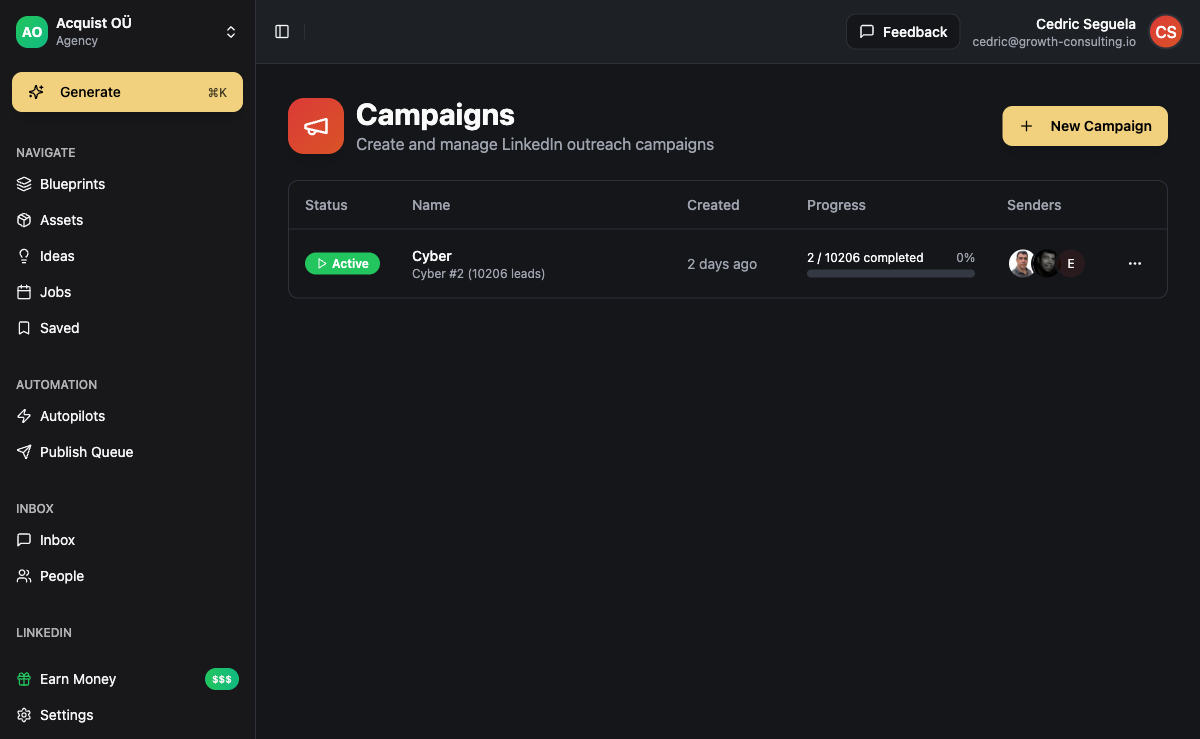
Email is one channel. ACA combines email + LinkedIn + WhatsApp so you stop relying on inbox luck.
When you add LinkedIn to your outreach sequence, the dynamic shifts. A LinkedIn connection request fires before or alongside the email. If the prospect opens the email but does not reply, a LinkedIn message reinforces the conversation from a different angle. If email deliverability is struggling for a segment, LinkedIn or WhatsApp may still reach them cleanly. In a multi-channel sequence, email open rate matters less because email is no longer the only path to a conversation.
This is how ACA runs outreach across six channels through a single sequence builder, using Unipile to coordinate LinkedIn, email, WhatsApp, Instagram, Telegram, and SMS. Replies from any channel land in a unified inbox. The campaign processor checks engagement state across all touchpoints before firing the next step - so prospects are never double-messaged and never fall through the cracks between channels.
For a practical walkthrough of multi-channel setup in ACA, the AI cold email guide covers personalization at scale alongside deliverability. The complete B2B cold email outreach guide covers campaign structure from lead import to reply handling. The cold email software comparison breaks down which tools handle multi-channel outreach versus email-only, and what the tradeoffs are when you need to scale beyond a single inbox.
In Cedric's experience running outbound for multiple agencies, reply rate consistently proved more meaningful than open rate as a campaign health signal. Switching to multi-channel sequences reduced the pressure on any single email to perform before a cold prospect went dark.
Frequently Asked Questions
What is a good cold email open rate in 2026?
For B2B cold email with proper authentication and warm-up, 35-50% is a healthy range. Below 25% is a deliverability warning - your emails are likely landing in spam. Above 55% consistently is probably MPP-inflated rather than genuine opens. The most useful benchmark is your own historical data: a 10% improvement in your own campaign metrics matters more than matching someone else's reported average. Industry averages vary by list quality, targeting precision, and how much of each list uses Apple Mail.
Has Apple Mail Privacy Protection made open rate tracking useless?
Not useless, but significantly less reliable as a performance signal. MPP inflates open rates for any list with a meaningful share of Apple Mail users - which includes most consumer email and a growing portion of business email on Mac and iOS. The practical adjustment: use open rate as a floor check (below 25% means investigate deliverability) but stop trying to maximize the number. Reply rate is a better engagement signal because replies require human intent. Positive reply rates are unaffected by MPP and track accurately regardless of what Apple does to pixel loading.
How do I know if my low open rate is a deliverability issue or a subject line issue?
Run a simple test: send your campaign email to seed accounts you control at Gmail, Outlook, and Yahoo. Check where it lands - primary inbox, promotions, or spam. If it lands in spam at seed accounts, you have a deliverability problem and subject line changes will not help until you fix it. If it lands in the primary inbox at seed accounts but campaign open rate is still low, the issue is targeting quality, subject line copy, or list hygiene (high percentage of invalid or unengaged addresses). Tools like GlockApps and MailReach automate this seed-account testing across dozens of mailbox providers simultaneously.
Should I stop tracking email opens entirely?
No. Despite its limitations, open rate tracking still provides useful signal. It tells you whether any emails are opening versus zero, it catches deliverability regressions when rates drop suddenly without copy changes, and it gives a relative comparison for A/B subject line tests within the same list. The key is treating it as a relative metric rather than an absolute truth. "My open rate dropped from 40% to 22% this week with no changes to copy" is highly actionable. "My open rate is 38%, is that good?" is the wrong question. Context and trend matter more than the number itself.
What should I optimize instead of open rate?
Reply rate is your primary north star for cold email performance. A reply - even a negative one - proves inbox placement, a working subject line, and enough message relevance for the recipient to respond. Positive reply rate (meetings booked, interested responses) is the ultimate metric because it measures actual pipeline generation. Secondary metrics worth tracking: inbox placement rate from seed account tests, bounce rate (under 3% hard bounces is healthy), and spam complaint rate (under 0.1% to stay out of Google's danger zone). Open rate sits behind all of these in diagnostic priority.